

The 2026 ASUS ROG Strix G16 G615 is a high-performance 16-inch gaming laptop with up to an Intel Core Ultra 9 290HX Plus processor, an RTX 5080 Laptop GPU at up to 175W, a 2.5K high-refresh display, extensive connectivity, and unusually easy access to its RAM and SSD slots. ASUS’s official specification lists a 240Hz panel mode with a 300Hz Armoury Crate mode, G-SYNC, a 3ms response time, a 90Wh battery, Thunderbolt 5, Wi-Fi 7, and a 380W adapter.
The laptop’s strengths are sustained gaming performance, fast competitive play, strong cooling design, modern ports, and ownership-friendly upgradeability. Its compromises are size, short real-world battery life under heavy use, a large charger, a plastic-heavy chassis, and some configuration confusion. Most importantly, buyers must check the exact G615 SKU: display type, memory speed, storage, CPU generation, GPU, and even chassis generation can vary.
Specifications
The G16 is a distinct product from the ROG Strix SCAR (higher-end configurations) and the thinner ROG Zephyrus G16. Model codes such as G615, G615LW, G615LR, and G614 matter — the specifications below reflect the representative 2026 configuration, with 2025 G615LW comparison points noted where relevant.
- Current processor: Up to Intel Core Ultra 9 290HX Plus, 24 cores/24 threads, up to 5.5GHz, Intel AI Boost NPU up to 13 TOPS
- 2025 comparison processor: Core Ultra 9 275HX in the independently tested G615LW
- Graphics: Up to NVIDIA GeForce RTX 5080 Laptop GPU, 16GB GDDR7, up to 175W with Dynamic Boost
- Display: 16-inch 16:10 2560×1600 ROG Nebula/Nebula HDR display; 240Hz standard, 300Hz via Armoury Crate, 3ms response, G-SYNC, Pantone validation, anti-glare
- 2025 display comparison: 2560×1600 matte IPS at 240Hz, 3ms, 500 nits, 100% DCI-P3 on the tested G615LW; lower-tier variants may use 1920×1200 at 165Hz
- Memory: 32GB DDR5 in two SO-DIMMs on the documented configuration; up to 64GB supported
- Storage: 2TB PCIe 4.0 NVMe SSD in the representative spec; two M.2 slots, some coverage reports PCIe Gen 5 readiness
- Graphics switching: MUX switch and NVIDIA Advanced Optimus
- Ports: HDMI 2.1 FRL, three USB 3.2 Gen 2 Type-A, two Thunderbolt 5, one USB 3.2 Gen 2 Type-C, 2.5Gbps Ethernet, 3.5mm combo audio
- Wireless: Wi-Fi 7 and Bluetooth (5.4 confirmed on the 2025 G615)
- Battery: 90Wh, 4-cell
- Power adapter: 380W AC adapter; up to 100W USB-C Power Delivery
- Cooling: End-to-end vapor chamber, sandwiched heatsink, tri-fan layout, liquid metal, ASUS Intelligent Cooling
- Weight: Approximately 2.65kg / 5.84lb on ASUS’s spec; independent coverage lists approximately 2.7kg
Design and Build Quality
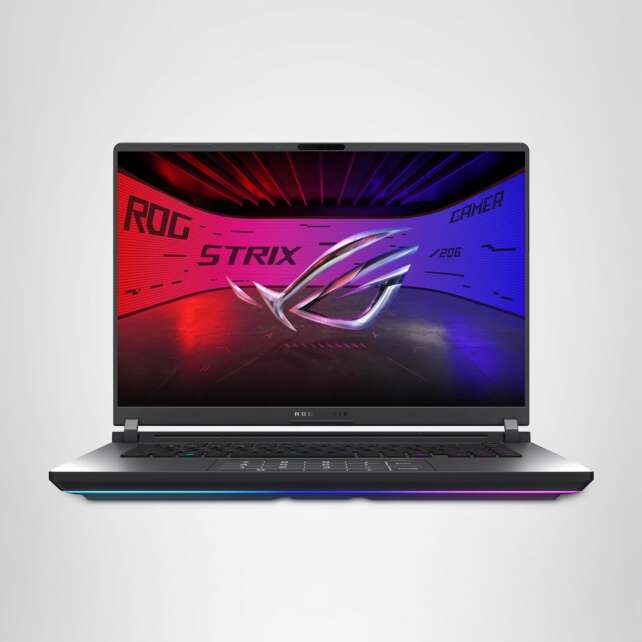
The 2026 G16 is a large, serious gaming laptop rather than an ultraportable, and the 380W power adapter adds significantly to the travel kit even though the laptop itself can fit in a large backpack. The visual design is more restrained than a SCAR — a relatively subtle powered-off appearance with the RGB light bar and ROG logo becoming more prominent once running, and Aura Sync allows the lighting to be customized or disabled entirely.
Description
The 2026 ASUS ROG Strix G16 G615 is a high-performance 16-inch gaming laptop with up to an Intel Core Ultra 9 290HX Plus processor, an RTX 5080 Laptop GPU at up to 175W, a 2.5K high-refresh display, extensive connectivity, and unusually easy access to its RAM and SSD slots. ASUS’s official specification lists a 240Hz panel mode with a 300Hz Armoury Crate mode, G-SYNC, a 3ms response time, a 90Wh battery, Thunderbolt 5, Wi-Fi 7, and a 380W adapter.The laptop’s strengths are sustained gaming performance, fast competitive play, strong cooling design, modern ports, and ownership-friendly upgradeability. Its compromises are size, short real-world battery life under heavy use, a large charger, a plastic-heavy chassis, and some configuration confusion. Most importantly, buyers must check the exact G615 SKU: display type, memory speed, storage, CPU generation, GPU, and even chassis generation can vary.
Positives
- Strong 2026 configuration with Core Ultra 9 290HX Plus and RTX 5080 at up to 175W.
- Fast 2.5K 16:10 display with 240Hz standard mode and 300Hz Armoury Crate mode.
- G-SYNC, 3ms response time, MUX switching, and Advanced Optimus suit competitive gaming.
- Effective 2026 cooling redesign with tri-fan layout, vapor chamber, and liquid metal.
- Keyboard remains comfortable during long gaming sessions in GadgetMatch’s hands-on use.
- Exceptionally easy access to RAM and SSD slots through latch-based service design.
- Up to 64GB memory and two M.2 slots provide useful long-term flexibility.
- Excellent connectivity, including Thunderbolt 5, HDMI 2.1, 2.5G Ethernet, and multiple USB ports.
- Wi-Fi 7, IR camera, Windows Hello, Dolby Atmos, and AI noise cancellation modernize the platform.
- 2.5K resolution is a practical balance between sharpness and high gaming frame rates.
Negatives
- Large and heavy for a 16-inch laptop, with a bulky 380W charger.
- Battery life is limited under gaming and only moderate during regular use.
- Fans are expected to become loud in high-performance modes.
- Plastic-heavy chassis does not feel as premium as the price category suggests.
- Large touchpad and unusual key feel may not suit every user.
- Exact display technology and brightness vary across regional and model-year materials.
- Lower-tier listings may use the older G614 chassis or weaker FHD+ display.
- G16 tops out below the RTX 5090 configurations available in the SCAR family.
- No card reader is listed in the 2025 G615 review, which may inconvenience creators.
Construction is practical rather than luxurious: a metal lid paired with a quality plastic main chassis on 2025 evidence, which reduces heat transfer to the user but doesn’t match a metal unibody’s premium feel. The 2026 model’s service design is the standout physical improvement — a release mechanism on the underside allows the cover to be removed with much less friction than a conventional screw-only panel, and Q-Latch makes SSD replacement easier, remaining sturdy after repeated openings.
Display and Gaming Performance
The documented 2026 panel is a 2560×1600 display with G-SYNC, a 3ms response time, Pantone validation, and a refresh rate reaching 300Hz through Armoury Crate — designed for both competitive responsiveness and high-detail gaming. The 16:10 aspect ratio adds vertical workspace for documents and timelines without feeling awkward in games. The 2025 G615L’s 2.5K 240Hz IPS panel was found to be one of the strongest IPS options at this size, at approximately 500 nits with full DCI-P3 coverage, though IPS black levels and contrast can’t match OLED or Mini LED.
The current G615 is designed around high sustained power: an RTX 5080 Laptop GPU at up to 175W, paired with a high-end Core Ultra 9 processor, a MUX switch, and Advanced Optimus — a much more performance-oriented setup than the thin-and-light Zephyrus G16. Independent 2026 evidence describes the Core Ultra 9/RTX 5080 combination as capable across spreadsheet work, video creation, and RTX-compatible gaming, while the 2025 G615LW comparison unit (up to 175W RTX 5080) was the top configuration in that generation, with an RTX 5070 Ti version at up to 140W offering a potentially strong value option. For AAA games, the 2560×1600 native resolution is a sensible target — sharper than 1080p but less punishing than 4K, giving the RTX 5080 a better chance of maintaining high frame rates, with DLSS 4 and frame generation providing additional headroom in supported games.
CPU Performance, Thermals, and Battery
The 2026 specification lists Intel Core Ultra 9 290HX Plus with 24 cores, 24 threads, a maximum 5.5GHz frequency, and an NPU rated up to 13 TOPS — positioning the G16 as a capable creator and multitasking machine, not merely a gaming device, useful for video editing, 3D work, software development, and virtual machines alongside a 16:10 display, 2.5G Ethernet, and Thunderbolt 5 ports for a desktop docking setup.
ASUS uses an aggressive cooling system: an end-to-end vapor chamber, sandwiched heatsink, tri-fan layout, and liquid-metal thermal interface material (Conductonaut Extreme on both CPU and GPU per one source), with a claimed up-to-15°C CPU-temperature improvement versus the previous compound — a vendor claim, though extended hands-on use found the keyboard remained comfortable after approximately three hours of Performance-mode gaming. The trade-off is fan noise: users should expect audible fans in Performance or Turbo modes when both CPU and GPU are loaded. The 90Wh battery delivers roughly four to five hours of regular use, up to about five and a half with idle time, and approximately three and a half hours under heavy gaming; the 380W charger restores the battery in about two to two and a half hours, and 100W USB-C charging is useful for lighter travel but not a gaming substitute.
Keyboard, Ports, and Upgradeability
The keyboard is centered and full-size in feel, with firm, relatively quiet feedback and a broad palm rest comfortable for extended gaming; the 2025 configuration used four-zone lighting rather than the SCAR’s per-key RGB. The large touchpad is smooth and functional, though its size and key-travel feel drew mixed reactions in hands-on testing. The 2026 platform lists a Full HD IR camera with Windows Hello, Dolby Atmos speakers with Smart Amp, Hi-Res Audio, and two-way AI noise cancellation.
Connectivity is unusually strong for a 16-inch laptop: HDMI 2.1 FRL, three USB-A ports, two Thunderbolt 5 ports, an additional USB-C port, 2.5G Ethernet, and 3.5mm audio, supporting external displays, fast storage, docking, and wired networking without immediately requiring a hub. Upgradeability is the G16’s strongest ownership feature — the 2026 chassis uses a release latch and Q-Latch system that exposes RAM and M.2 slots far more easily than a conventional bottom cover, with two SO-DIMM slots, a 64GB memory ceiling, and two M.2 slots, letting an owner add memory or another SSD without the usual intimidating screw-heavy process.
Frequently Asked Questions
Is the ASUS ROG Strix G16 a good gaming laptop?
Yes. The 2026 G615 combines a high-end Core Ultra 9 processor, RTX 5080 graphics at up to 175W, a fast 2.5K display, G-SYNC, MUX switching, and strong cooling, particularly attractive for 1600p gaming and competitive titles. The main caveats are its size, noise, battery life, and the need to verify the exact configuration.
What’s the difference between the 2026 and 2025 ROG Strix G16?
The 2026 G615 uses the newer Core Ultra 9 290HX Plus platform and a revised cooling and service-access design. The 2025 G615LW used Core Ultra 9 275HX, RTX 5080, and a 240Hz 2.5K IPS display. Some 2025 and lower-tier products also use the older G614 chassis.
Does the ROG Strix G16 have a 300Hz display?
ASUS’s 2026 specification lists 240Hz as standard and 300Hz enabled through Armoury Crate on the documented configuration. Some 2025 units use a 240Hz panel, while lower-tier versions may use a 165Hz FHD+ display. Confirm the exact SKU before purchase.
How upgradeable is the laptop?
Unusually so. The 2026 G615 has a latch-based bottom cover, Q-Latch SSD retention, two memory slots supporting up to 64GB of RAM, and two M.2 slots. Always disconnect power, follow ASUS service instructions, and verify warranty terms before opening the system.
Should I buy the Strix G16 or the Strix SCAR?
Choose the Strix G16 for high performance and upgradeability at a potentially lower price than a SCAR. Choose a SCAR for the higher-tier configuration ceiling or a specific Mini LED/RTX 5090 option. The best choice depends on final price and exact display/GPU package rather than the name alone.
Verdict
The ASUS ROG Strix G16 is one of the more compelling performance-first 16-inch gaming laptops because it gets the fundamentals right: a high-power RTX 5080 option, a high-end Core Ultra processor, a fast 2.5K display, strong connectivity, modern wireless standards, and a cooling system designed for sustained use. The 2026 model’s latch-based internal access is a particularly valuable improvement, making memory and storage upgrades feel like part of normal ownership rather than an intimidating repair project.
It’s not a perfect all-purpose laptop — it’s heavy, its 380W adapter is cumbersome, battery life is short under serious workloads, and the chassis and input design don’t feel as premium as the best metal-bodied competitors. ASUS’s overlapping G615, G614, 2025, and 2026 configurations also make it easy to buy a weaker display or older platform while assuming you’re getting the headline specification. Buy the right SKU and the G16 is an excellent choice for 1600p gaming, esports, creation, and long-term upgradeability. Overall, it earns 4 out of 5 stars.
