

The ASUS ROG Swift OLED PG27AQWP-W is a 26.5-inch QHD OLED monitor with a dual-mode design: 2560 × 1440 at up to 540Hz, or 1280 × 720 at up to 720Hz. ASUS describes it as a world-fast OLED monitor, and it is built around fourth-generation Tandem OLED technology paired with a glossy TrueBlack surface designed to preserve clarity and contrast.
This is best understood as a premium dual-mode esports monitor rather than a conventional all-purpose 4K display. Its strongest areas are the combination of 1440p at 540Hz and 720p at 720Hz, exceptional OLED response, brighter Tandem OLED performance versus older WOLED panels, glossy image clarity, DisplayPort 2.1, HDMI 2.1, wide color, and strong HDR. Its main drawbacks are a very high likely price, the need for powerful hardware to exploit 540Hz or 720Hz, glossy reflections in sunny rooms, visible text fringing, VRR flicker, dark-gray uniformity issues, OLED burn-in risk, and reduced image quality in the 720p dual mode.
Specifications
- Model: ASUS ROG Swift OLED PG27AQWP-W
- Display size: 26.5-inch glossy WOLED, Tandem OLED technology
- Dual-mode resolution: 2560 × 1440 at up to 540Hz, or 1280 × 720 at up to 720Hz
- Response time: 0.02ms gray-to-gray specification
- Color: 99.5% DCI-P3, 10-bit color, HDR10 support
- Contrast: 1,500,000:1 specification per TechPorn
- Connectivity: Two HDMI 2.1 ports, DisplayPort 2.1a UHBR20 (80Gbps), three USB-A ports, 3.5mm audio output
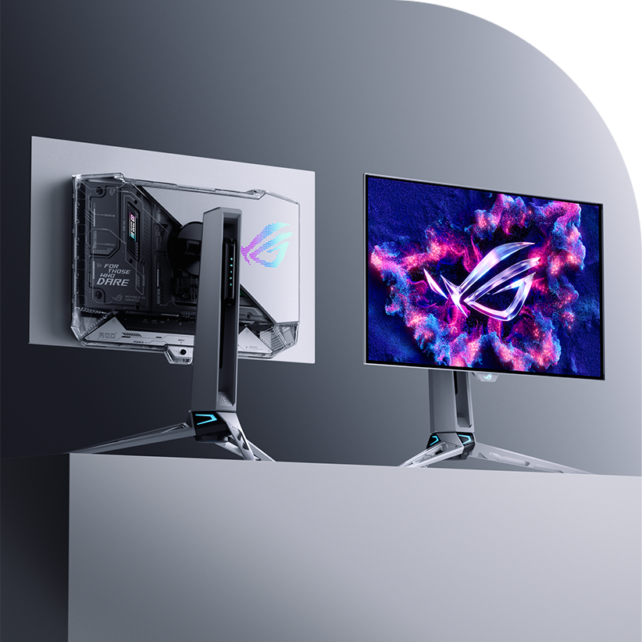
- Design: Silver finish, transparent rear panel, hollow tripod-style stand with an integrated 1/4-inch tripod socket
- Ergonomics: 110mm height adjustment, 60° total swivel, 25° tilt, 90° pivot, 100 × 100mm VESA
- OLED protection: OLED Care Pro, OLED Anti-Flicker, a Neo Proximity Sensor
- Measured brightness (TechPorn): Up to 332.7 cd/m² SDR, approximately 1,219.6 cd/m² HDR peak at a 1% window, 338 cd/m² full-field HDR
- Measured color (TechPorn): 100% sRGB, 95% AdobeRGB, 100% DCI-P3, average Delta E of 0.77
Gaming Performance
RTINGS found the PG27AQWP-W fantastic for PC gaming, with sharp motion at all refresh rates, low input lag at every tested refresh rate, full HDMI and DisplayPort 2.1 bandwidth, common VRR support, deep blacks, bright HDR highlights, and a wide color range. Its main weaknesses were noticeable VRR flicker and uniformity issues in dark grays.
The 540Hz mode is intended to retain full 1440p image quality for most gaming, while the 720p/720Hz Frame Rate Boost mode targets esports titles where maximum frame rate and motion clarity matter more than resolution. TechPorn confirms that 1440p at 540Hz can operate without relying on DSC thanks to the full-bandwidth DisplayPort 2.1a connection.
Description
The ASUS ROG Swift PG27AQWP-W combines QHD at 540Hz with a 720p/720Hz esports mode, Tandem OLED brightness, excellent contrast, and DisplayPort 2.1. It is exceptionally fast and versatile, but expensive, demanding on hardware, reflective in sunny rooms, and still subject to OLED burn-in and text-fringing concerns.Positives
- QHD at 540Hz delivers exceptional competitive-gaming motion clarity.
- The 720p at 720Hz mode provides an extreme esports-focused alternative.
- Tandem OLED improves brightness, color volume, and expected panel longevity over older WOLED designs.
- OLED produces deep blacks, excellent contrast, and no traditional LCD blooming.
- Glossy TrueBlack Glossy coating gives images strong clarity and visual depth in controlled lighting.
- DisplayPort 2.1a UHBR20 provides full 80Gbps bandwidth for modern high-end graphics cards.
- Two HDMI 2.1 ports support current gaming consoles and high-refresh PC connections.
- Strong HDR highlights and wide color gamut make games and video look vivid.
- Full ergonomic adjustment and a stable tripod-style stand.
- Fanless cooling avoids active-fan noise.
- OLED Care Pro and Neo Proximity Sensor help reduce burn-in risk
Negatives
- Premium pricing makes it difficult to recommend for ordinary gaming setups.
- 540Hz and especially 720Hz require a powerful PC and games capable of very high frame rates.
- The 720p mode is dramatically less detailed than QHD and is mainly useful for esports.
- Glossy coating can produce distracting mirror-like reflections in sunny rooms.
- RTINGS observed noticeable VRR flicker when frame rates change.
- RTINGS also noted dark-gray uniformity issues that may appear in some scenes.
- Text fringing remains a limitation for reading and productivity work.
- OLED burn-in remains possible with prolonged exposure to static content.
- HDR brightness decreases as the bright area becomes larger because of OLED brightness management.
- A 27-inch QHD format offers less desktop detail than a 4K monitor.
For console gaming, RTINGS found the monitor supports most current console signals, including downscaled 4K at 120Hz, and supports VRR on both PS5 and Xbox Series X|S. It noted the monitor is not a native 4K display and that the dark-gray uniformity issue may be visible in some console games.
Image Quality and the Glossy TrueBlack Coating
ASUS says the fourth-generation Tandem OLED technology delivers 15% higher peak brightness, 25% larger color volume, and 60% longer OLED lifespan than previous-generation WOLED panels. RTINGS confirms the Tandem OLED panel is brighter than older models and offers more brightness and color than previous WOLED generations, though colors are not quite as bright as those from comparable QD-OLED panels.
TechPorn’s independent measurements back this up, recording SDR brightness up to 332.7 cd/m², HDR peak brightness of approximately 1,219.6 cd/m² at a 1% window, and 338 cd/m² at a full-field HDR window, along with 100% sRGB, 95% AdobeRGB, and 100% DCI-P3 coverage with an average Delta E of just 0.77. TechPorn praised the TrueBlack Glossy surface for image clarity and contrast, but noted that a glossy finish requires careful room-lighting control — though it reported no perceptible glare while the display was active in its own test environment.
Office Use, Content Creation, and Design
For office use, RTINGS found the monitor bright enough to fight glare in most well-lit rooms and praised its viewing angles and ergonomics, though mirror-like reflections can be distracting in sunny rooms and text fringing reduces text clarity. For content creation, RTINGS found superb contrast, bright highlights, wide color, and good out-of-box accuracy, recommending calibration to correct white-balance and gamma issues.
TechPorn highlighted the design details: a silver finish, transparent rear section, hollow tripod-style stand, 110mm height adjustment, 60 degrees of total swivel, 25 degrees of tilt, 90-degree pivot, 100 × 100mm VESA compatibility, and an integrated 1/4-inch tripod socket for cameras or lights — an unusual but useful touch for streamers.
Frequently Asked Questions
What is the point of the 720Hz mode?
The 720p/720Hz Frame Rate Boost mode targets esports games where maximum frame rate and motion clarity matter more than resolution, trading some detail for even faster response than the native 540Hz mode.
Is the glossy coating a problem in bright rooms?
It can be. RTINGS noted mirror-like reflections can be distracting in sunny rooms, though TechPorn reported no perceptible glare in its own controlled test environment. Room lighting matters more with a glossy panel than a matte one.
Does it support console gaming?
Yes. RTINGS found support for most current console signals, including downscaled 4K at 120Hz and VRR on both PS5 and Xbox Series X|S.
Is this a 4K monitor?
No. It’s native 1440p, switching to 720p in its high-speed mode. It is designed around refresh rate rather than resolution.
What’s the biggest weakness reviewers found?
Noticeable VRR flicker and uniformity issues in dark grays were RTINGS’ most consistent criticisms, alongside the usual OLED burn-in risk and text fringing common to QD-OLED and Tandem OLED subpixel layouts.
Verdict
The ASUS ROG Swift OLED PG27AQWP-W is a premium dual-mode esports monitor built for buyers who want maximum refresh-rate flexibility in one screen. Its 540Hz native mode, 720Hz Frame Rate Boost mode, brighter Tandem OLED panel, glossy TrueBlack clarity, DisplayPort 2.1, and strong measured color accuracy make it one of the most capable competitive-gaming displays available.
Its trade-offs are the usual premium-OLED considerations, amplified by the glossy finish: reflections in bright rooms, VRR flicker, dark-gray uniformity issues, text fringing, and burn-in risk. Buyers should also budget for a powerful GPU to actually exploit 540Hz or 720Hz. For serious esports players who want the fastest OLED experience on the market, it’s a compelling if expensive choice.
