

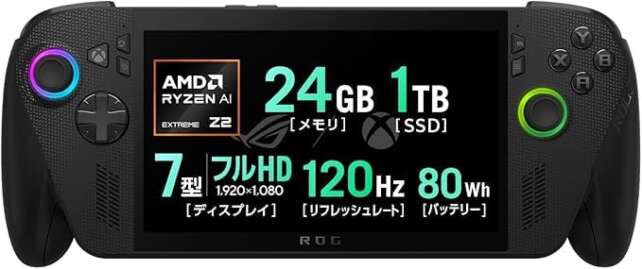
The ASUS ROG Xbox Ally X is a premium Windows gaming handheld built around AMD’s Ryzen AI Z2 Extreme, 24 GB of LPDDR5X memory, a 1 TB PCIe 4.0 SSD, an 80 Wh battery, and a 7-inch 1080p/120 Hz IPS display. Its biggest improvements over earlier ROG handhelds are not just processor-related: the deeper controller-style grips, stronger battery capacity, USB4 connectivity, UHS-II microSD reader, Xbox button, and Xbox Full Screen Experience make the device more comfortable and more console-like to use.
It is still a Windows PC rather than a native Xbox console. That distinction matters because the Ally X can access supported Xbox and other PC storefront games, cloud gaming, Remote Play, mods, and desktop software, but retains Windows’ launcher, driver, anti-cheat, and per-game configuration complications. At $999.99, it is powerful and unusually well equipped, but its 715 g weight, LCD display, premium price, audible cooling, and inconsistent AAA performance make it a specialist purchase rather than an automatic Steam Deck alternative.
The ROG Xbox Ally X is the high-end member of the 2025 ROG Xbox Ally family. It combines a Ryzen AI Z2 Extreme processor with 24 GB LPDDR5X-8000 memory and a 1 TB PCIe 4.0 SSD, while the base ROG Xbox Ally uses a lower-tier Ryzen Z2 A processor, 16 GB of memory, and 512 GB storage. Xbox lists the Ally X at $999.99 estimated retail price and the base Ally at $599.99, so the X is not merely a cosmetic variant; it is a materially more capable configuration with a larger battery and more advanced I/O.
The most convincing aspect of the Ally X is its hardware balance. The 80 Wh battery is unusually large for a handheld, the 7-inch 120 Hz screen supports VRR, the controls are built into comfortable grips, and the USB4 port expands docking and external-GPU possibilities. ASUS claims up to 9.9 hours in a light-game test and up to 2.7 hours in a heavy-AAA test, but those figures come from carefully defined 13 W and 17 W scenarios. Independent testing is more useful as a practical guide: Wccftech reports that an hour of Red Dead Redemption 2 in Turbo mode consumed roughly half the battery, while the reviewer found 17 W Performance mode more attractive for sustained play.
Description
The ASUS ROG Xbox Ally X is a premium Windows gaming handheld built around AMD’s Ryzen AI Z2 Extreme, 24 GB of LPDDR5X memory, a 1 TB PCIe 4.0 SSD, an 80 Wh battery, and a 7-inch 1080p/120 Hz IPS display. Its biggest improvements over earlier ROG handhelds are not just processor-related: the deeper controller-style grips, stronger battery capacity, USB4 connectivity, UHS-II microSD reader, Xbox button, and Xbox Full Screen Experience make the device more comfortable and more console-like to use.It is still a Windows PC rather than a native Xbox console. That distinction matters because the Ally X can access supported Xbox and other PC storefront games, cloud gaming, Remote Play, mods, and desktop software, but retains Windows’ launcher, driver, anti-cheat, and per-game configuration complications. At $999.99, it is powerful and unusually well equipped, but its 715 g weight, LCD display, premium price, audible cooling, and inconsistent AAA performance make it a specialist purchase rather than an automatic Steam Deck alternative.
Positives
- Large 80 Wh battery: the capacity is a major advantage for a high-performance Windows handheld, and ASUS’s controlled light-game test reaches up to 9.9 hours.
- Powerful integrated platform: Ryzen AI Z2 Extreme, 24 GB LPDDR5X-8000, and 1 TB PCIe 4.0 storage place the X at the premium end of handheld PC hardware.
- Comfortable controller-style grips: Wccftech and LaptopMedia both found the redesigned shape comfortable for long sessions despite its 715 g weight.
- Good high-refresh display: 1080p, 120 Hz, VRR, Gorilla Glass Victus, and anti-reflection treatment are well matched to handheld gaming.
- Useful premium I/O: USB4, DisplayPort 2.1, Power Delivery, Thunderbolt 4 compatibility, a second USB-C port, and UHS-II microSD support improve docking and expansion.
- Xbox-oriented software: the Full Screen Experience, Xbox button, Game Bar, library aggregation, Remote Play, and compatibility badges make Windows more approachable.
- Excellent D-pad and responsive controls: the independent review particularly praised platform-game control and trigger feel.
- Strong upgrade ceiling: optional ROG XG Mobile support can add substantial desktop-style GPU performance, although it is not included.
Negatives
- High $999.99 price: it is a premium purchase and materially more expensive than the base ROG Xbox Ally.
- Still Windows underneath: the Xbox interface improves the experience but does not remove launcher, driver, anti-cheat, update, and game-configuration friction.
- Heavy and thick: the 715 g mass and deep grips improve comfort for some users but reduce portability.
- No OLED: black levels and contrast cannot match OLED handhelds, and LaptopMedia measured a sample contrast ratio of about 1280:1.
- AAA performance is inconsistent: independent testing found strong results in some games but unstable frame rates and at least one demanding title that the reviewer did not recommend.
- Battery claims require context: the 9.9-hour and 2.7-hour figures come from specific low-power test scenarios and do not represent every game or power mode.
- Top-button layout can cause accidental presses: Wccftech found too many overlapping shortcut controls around the screen.
- External GPU and accessories cost extra: XG Mobile, docks, cases, and expanded storage are not part of the standard hardware value.
- No native Xbox-console OS experience: Xbox features are integrated into Windows rather than replacing Windows with a console operating system.
The Xbox software layer is a real usability improvement. Booting into an Xbox-oriented full-screen interface, using the Xbox button for Game Bar and quick controls, and receiving handheld compatibility indicators can reduce the friction traditionally associated with Windows handhelds. It does not eliminate Windows underneath, however, and the device still depends on game-specific optimization. Wccftech found smooth 60-fps performance in Forza Horizon 5 and around 40 fps in Red Dead Redemption 2 with appropriate settings, but also reported inconsistent frame rates across several AAA games and did not recommend DOOM: The Dark Ages on the tested unit.
Specifications
- Processor: AMD Ryzen AI Z2 Extreme; Wccftech reports 8 cores/16 threads, Zen 5, up to 5 GHz boost, RDNA 3.5 graphics with 16 compute units up to 2.9 GHz, and an NPU rated up to 50 TOPS.
- Operating system: Windows 11 Home with Xbox Full Screen Experience, Xbox Mode, Game Bar, Xbox Remote Play, Xbox Cloud Gaming support, and access to supported third-party PC storefronts.
- Memory: 24 GB LPDDR5X-8000 shared system memory; it is not dedicated VRAM and is not presented as user-upgradable.
- Storage: 1 TB M.2 2280 PCIe 4.0 NVMe SSD.
- Display: 7-inch IPS panel, 1920 × 1080, 16:9, 120 Hz, AMD FreeSync Premium/VRR, Gorilla Glass Victus, and anti-reflection coating.
- Independent display measurements: LaptopMedia measured approximately 456 cd/m² at the center, 419 cd/m² averaged across the surface, 94% sRGB coverage, 75% DCI-P3 coverage, and 1280:1 contrast on its sample.
- Controls: integrated Xbox-style ABXY controls, D-pad, analog sticks, analog triggers, bumpers, rear macro buttons, Xbox button, Command Center/Armoury Crate controls, and impulse-trigger haptics reported by independent testing.
- Battery: 80 Wh.
- ASUS battery examples: up to 9.9 hours for light gaming in Silent 13 W mode and up to 2.7 hours for heavy AAA gaming in Performance 17 W mode, under ASUS’s specified test conditions.
- Power modes: Silent 13 W, Performance 17 W, Turbo 25 W, and a plugged-in 35 W Turbo-Turbo mode reported by Wccftech.
- USB-C ports: one USB4 port with DisplayPort 2.1, Power Delivery 3.0, and Thunderbolt 4 compatibility, plus one USB 3.2 Gen 2 port with DisplayPort 2.1 and Power Delivery 3.0.
- Card reader: UHS-II microSD reader with support for SD, SDHC, SDXC, and UHS-I DDR200 mode according to the ASUS/Xbox comparison information.
- Audio: 3.5 mm combo jack, stereo speakers with Smart Amp/Dolby Atmos support, and array microphones with AI noise cancellation.
- Wireless: Wi-Fi 6E and Bluetooth 5.4 in ASUS/Xbox specifications; LaptopMedia identifies Wi-Fi 6E and Bluetooth support in its tested configuration.
- Biometrics: fingerprint reader integrated into the power button.
- Chassis: approximately 290.8 × 121.5 × 50.7 mm and 715 g in the ASUS/Xbox specification comparison.
- Included charger: 65 W USB-C charger.
- Included stand: cardboard tabletop kickstand/stand reported by independent reviewers.
- External GPU support: optional ROG XG Mobile accessory, which ASUS says can provide up to RTX 5090 Laptop GPU performance; the accessory is not included.
- U.S. configuration: 24 GB RAM and 1 TB storage at $999.99 ERP on Xbox’s U.S. page; three months of Xbox Game Pass Premium are listed as included, subject to offer terms.
Detailed Product Analysis
Exact model and naming boundaries
The product in this review is the 2025 ASUS ROG Xbox Ally X, not the 2024 ROG Ally X. The 2025 device is commonly identified as RC73XA and uses Ryzen AI Z2 Extreme, while the 2024 ROG Ally X is RC72LA with Ryzen Z1 Extreme. The Xbox-branded model also adds the Xbox software experience, a redesigned black controller-style chassis, faster LPDDR5X-8000 memory, and a different I/O arrangement. A retailer that shortens the name to “ROG Ally X” can therefore create a serious risk of mixing two generations.
The Ally X should also be kept separate from the base ROG Xbox Ally. Xbox lists the base model at $599.99 with 16 GB RAM, 512 GB storage, 60 Wh battery, and AMD Ryzen Z2 A, while the Ally X costs $999.99 with 24 GB, 1 TB, 80 Wh, and Ryzen AI Z2 Extreme. The base model’s performance, endurance, memory, and port claims should not be transferred to the X, and vice versa.
Finally, the Ally X is not an Xbox Series console in handheld form. It is a Windows 11 Home PC with Microsoft’s Xbox interface, account synchronization, Game Bar, storefront integration, cloud gaming, and Remote Play. Games that support Xbox Play Anywhere can carry qualifying saves and entitlements across supported devices, but the handheld’s broad compatibility remains governed by Windows and the individual game.
Performance and the Ryzen AI Z2 Extreme
The Ryzen AI Z2 Extreme gives the Ally X a high-end integrated-GPU platform for a handheld. Wccftech’s comparison reports eight Zen 5 CPU cores with 16 threads, RDNA 3.5 graphics with 16 compute units, up to 2.9 GHz graphics boost, and a 50-TOPS NPU. These figures explain the premium positioning, but they do not guarantee a fixed frame rate: handheld performance varies with power mode, resolution, upscaling, driver, graphics preset, VRR range, game engine, and whether the system is plugged in.
Wccftech’s practical results illustrate the point better than a processor label. Forza Horizon 5 was the strongest example, with a consistent smooth 60 fps reported by the reviewer. Red Dead Redemption 2 reached roughly 40 fps in 17 W Performance mode with high settings and dropped toward 30 fps in Silent mode. In contrast, the reviewer found frame consistency difficult across several games and did not recommend DOOM: The Dark Ages on the tested handheld. The Ally X is therefore best understood as a flexible 30–60-fps machine whose performance ceiling is high but whose sustained result remains game dependent.
The 24 GB memory capacity helps because the integrated Radeon graphics share system memory with the CPU. It gives the operating system and GPU more room than a typical 16 GB handheld, but it is still shared memory rather than dedicated VRAM. Buyers should not expect the hardware to behave like a laptop with 24 GB of RAM plus a separate graphics-memory pool.
Xbox Full Screen Experience and Windows usability
The Xbox Full Screen Experience is the product’s defining software change. Xbox describes an Xbox Mode that can start directly into a controller-oriented full-screen interface, a Game Bar opened with the dedicated Xbox button, a collective library that can include supported Xbox and other PC storefront games, synchronized saves and achievements, cloud gaming, and Remote Play. ASUS also describes a handheld compatibility program that uses badges such as “Should play great” to help users identify titles requiring fewer manual adjustments.
This is a meaningful improvement over the historically awkward Windows handheld workflow. It makes the device easier to pick up, browse, resume, and control without immediately reaching for a desktop or touchscreen. Nevertheless, the underlying Windows environment remains available and sometimes necessary for driver updates, launcher authentication, compatibility fixes, game settings, mods, file management, and anti-cheat troubleshooting. Wccftech’s observation that the device is “definitely not an Xbox” in the traditional console sense is the right framing: the software feels more console-like, but it is still a PC.
The multi-store promise is a strength for users with existing libraries in Xbox, Steam, Epic, GOG, and other supported PC ecosystems. It is also a source of complexity because each storefront can have its own overlay, save behavior, launcher state, controller mapping, and update path. SteamOS offers a more curated experience; the Ally X offers broader Windows compatibility and deeper desktop flexibility.
Display quality
The Ally X uses a 7-inch, 1920 × 1080 IPS display with 120 Hz refresh and VRR rather than OLED. Wccftech considers the display serviceable and argues that retaining an efficient IPS panel helps battery life and avoids making the already expensive handheld even more costly. The 120 Hz refresh and FreeSync/VRR support are useful because many demanding games will operate between 30 and 60 fps rather than at a locked 120 fps.
LaptopMedia measured approximately 456 cd/m² in the center, 419 cd/m² average, 94% sRGB, 75% DCI-P3, and 1280:1 contrast on its sample. Those results indicate a bright, reasonably colorful panel for indoor and many portable situations, but not a wide-gamut HDR reference display. The absence of OLED means black levels and contrast are not in the same class as Steam Deck OLED or other OLED handhelds, even though the IPS panel can be advantageous for efficiency and text clarity.
At seven inches, 1080p is a sensible resolution. Running every game at native resolution is not always practical, so the Ally X benefits from sensible use of resolution scaling, AMD upscaling, and frame-generation features where a particular title supports them. The display should be judged as a good high-refresh handheld panel, not as a substitute for a large HDR monitor.
Ergonomics, controls, and portability
ASUS reshapes the Xbox Ally X around deeper controller-style grips. Wccftech found the 715 g body comfortable for extended sessions, with pleasantly positioned thumbsticks, smooth triggers, clicky rear buttons, and a strong D-pad for platformers such as Celeste. LaptopMedia similarly found the plastic/polycarbonate body sturdy, with no obvious creaking or flex, and considered the grips comfortable despite the weight.
The weight and thickness are the price of that comfort and the 80 Wh battery. At 715 g and approximately 50.7 mm deep at the grip/body profile, the X is much more substantial than a lightweight console-style handheld. It is portable in a backpack, but it is not a device users will forget is in their hands after several hours. The extra mass is more defensible for players who value battery life and ergonomics than for buyers who prioritize the smallest possible travel device.
The control layout is broadly familiar, with Xbox ABXY buttons, D-pad, analog sticks, triggers, bumpers, rear macro buttons, and an Xbox button. The premium model adds impulse-trigger haptics according to LaptopMedia. Wccftech’s main criticism is that the upper edge has too many overlapping shortcut buttons, including Xbox, Armoury Crate, library, and menu functions, which can lead to accidental presses. The fingerprint reader in the power button is a useful counterpoint because it makes waking into Windows faster and less frustrating.
Battery life and power modes
The 80 Wh battery is one of the Ally X’s best hardware advantages. ASUS reports up to 9.9 hours in a light-gaming scenario and up to 2.7 hours in a heavy-AAA scenario, but the test conditions are essential: the light result uses Hollow Knight: Silksong at 1080p, a 60-fps cap, low settings, Silent 13 W mode, 75% brightness, Wi-Fi enabled, Bluetooth on, and 50% volume; the heavy result uses Cyberpunk 2077 at 1080p, a 60-fps cap, low settings, and Performance 17 W mode under similar connectivity conditions. These figures demonstrate a best-case light workload and a defined heavy workload, not a universal range for every game.
Wccftech’s independent use is more conservative and more relevant to demanding games. After one hour of Red Dead Redemption 2 in Turbo mode, the reviewer reported that the battery had fallen to about 50%. The same review found 17 W Performance mode capable of handling many games while giving up less battery life than 25 W or plugged-in 35 W Turbo-Turbo mode. This supports a practical recommendation: use Silent for light games, Performance as the everyday default, and Turbo when a demanding game genuinely benefits and access to a charger is acceptable.
The optional 35 W plugged-in mode is valuable for performance at a desk, but it is not a portable 35 W operating point. The included 65 W charger is enough for normal charging and handheld operation, while a dock or higher-wattage charger may be useful for a monitor, peripherals, or long desktop sessions.
Ports, docking, storage, and expansion
The Ally X has a strong port selection for a handheld. Its USB4 port supports DisplayPort 2.1, Power Delivery 3.0, and Thunderbolt 4 compatibility; the second USB 3.2 Gen 2 USB-C port also supports DisplayPort and Power Delivery. Together they make docking, charging, external displays, and high-speed peripherals more flexible than on many one-port handhelds.
The UHS-II microSD reader is another practical upgrade. It can accept SD, SDHC, and SDXC media, and ASUS/Xbox documentation references UHS-I DDR200 mode. A fast card can expand the library, but internal PCIe 4.0 SSD performance remains preferable for demanding games and frequent installs. The internal M.2 2280 SSD is a more meaningful upgrade path for users willing to open the chassis, while memory is soldered/shared and should be treated as fixed.
ASUS also promotes compatibility with ROG XG Mobile. The company says the external unit can provide up to RTX 5090 Laptop GPU performance and more desktop-class ports. This can turn the Ally X into a compact desktop setup, but the XG Mobile is an additional purchase and should not be included in the handheld’s base value calculation.
Audio, microphone, and accessories
The integrated stereo speakers support Smart Amp and Dolby Atmos according to ASUS/Xbox and LaptopMedia. They are suitable for handheld play, menus, and casual listening, while the 3.5 mm combo jack supports wired headsets. The built-in microphone array includes AI noise cancellation, which is useful for chat and portable calls.
The standard package includes the handheld, a 65 W charger, manuals/warranty materials, and a small cardboard stand according to independent reviews. Xbox lists three months of Game Pass Premium with the U.S. product, but this is a subscription promotion with redemption and regional terms rather than a permanent hardware feature. The official ROG 100 W Gaming Charger Dock, ROG 2-in-1 Premium Case, microSD cards, and ROG XG Mobile are optional accessories and should not be described as included.
Noise, heat, and long-term value
A high-performance handheld must trade among power, heat, acoustics, and battery life. The Ally X’s larger body and dual USB-C arrangement give it useful thermal and I/O headroom, but high-wattage operation still increases fan noise and reduces battery life. LaptopMedia’s review includes dedicated thermal, noise, and stability testing, while Wccftech’s real-world results show why 17 W Performance can be a more comfortable long-session mode than Turbo.
The value argument depends heavily on what the buyer wants. At $999.99, the Ally X is expensive beside the Steam Deck OLED and the base ROG Xbox Ally, but it offers more memory, a larger battery, faster integrated hardware, USB4, and a broad Windows library. It is strongest for users who want one handheld to cover Xbox, PC storefronts, Game Pass, desktop work, mods, external displays, and possible XG Mobile expansion. It is weaker for buyers who want SteamOS simplicity, OLED contrast, a low price, or guaranteed 60-fps AAA performance.
Frequently Asked Questions
Is the ASUS ROG Xbox Ally X an Xbox console?
No. It is a Windows 11 Home PC handheld with an Xbox Full Screen Experience, Xbox Game Bar, Xbox account integration, Cloud Gaming, Remote Play, and access to supported PC storefronts. It can feel more console-like than earlier Windows handhelds, but it is not a native Xbox Series console.
What is the difference between ROG Xbox Ally X and ROG Xbox Ally?
The ROG Xbox Ally X is the premium model, listed at $999.99 with Ryzen AI Z2 Extreme, 24 GB memory, 1 TB storage, and an 80 Wh battery. The base ROG Xbox Ally is listed at $599.99 with Ryzen Z2 A, 16 GB, 512 GB, and a 60 Wh battery.
Is ROG Xbox Ally X the same as the 2024 ROG Ally X?
No. The 2025 ROG Xbox Ally X uses Ryzen AI Z2 Extreme and Xbox branding/software, while the 2024 ROG Ally X uses Ryzen Z1 Extreme and is identified as RC72LA in the comparison coverage. Their chassis, processor, memory speed, software experience, and naming should be kept separate.
How long does the battery last?
ASUS claims up to 9.9 hours for a defined light-game test and up to 2.7 hours for a defined heavy-AAA test. In independent use, Wccftech reported roughly 50% battery consumption after one hour of Red Dead Redemption 2 in Turbo mode. Actual life depends on game, wattage, resolution, frame cap, screen brightness, networking, and audio.
Can it run Steam and other PC game stores?
Yes, because it is a Windows 11 PC. Xbox and ASUS describe access to supported games from Xbox and other PC stores. Storefront compatibility, launcher behavior, anti-cheat, saves, and controller support remain title and platform dependent.
Does it support Xbox Cloud Gaming and Remote Play?
Yes, Xbox and ASUS list Xbox Cloud Gaming and Xbox Remote Play. Cloud Gaming requires a compatible Game Pass membership/service condition, while Remote Play requires a suitable Xbox console, network, account, and supported game setup.
Can the Ally X connect to an external GPU?
ASUS says the ROG XG Mobile can connect and provide up to RTX 5090 Laptop GPU performance, but this is an optional accessory and not part of the $999.99 handheld package.
Does the Ally X have an OLED screen?
No. It has a 7-inch 1920 × 1080 IPS display with 120 Hz refresh and VRR. The IPS design can support efficiency and brightness, but it does not provide OLED-level black levels.
How heavy is the ROG Xbox Ally X?
The ASUS/Xbox comparison lists approximately 715 g, with dimensions around 290.8 × 121.5 × 50.7 mm. The deep grip profile contributes to comfort for some players but also makes it a substantial handheld.
What comes in the box?
Independent reviews report the handheld, a 65 W charger, manuals/warranty materials, and a cardboard tabletop stand. Game Pass Premium is listed as a three-month promotional inclusion in the U.S. Xbox offer. The XG Mobile, premium case, 100 W dock, and microSD cards are optional accessories.
Important Caveats
Battery numbers are test-specific. ASUS’s up-to-9.9-hour and up-to-2.7-hour results use named games, resolution, frame cap, graphics settings, wattage mode, screen brightness, networking, Bluetooth, and volume conditions. They should not be used as a promise for demanding games at Turbo power.
Performance is not a fixed console profile. The Ryzen AI Z2 Extreme is powerful for a handheld, but frame rate depends on drivers, game engine, graphics settings, upscaling, frame generation, wattage, VRR, and whether the device is plugged in. Independent testing found both smooth 60-fps results and games with inconsistent performance.
The display measurements are sample measurements. LaptopMedia’s approximately 456 cd/m² center brightness, 419 cd/m² average, 94% sRGB, 75% DCI-P3, and 1280:1 contrast belong to its review sample, not a universal ASUS guarantee.
Xbox software does not equal Xbox console compatibility. Xbox Mode and Full Screen Experience improve navigation, but Windows remains underneath. Storefronts, launchers, anti-cheat systems, mods, and games can behave differently from a console environment.
Memory is shared. The 24 GB LPDDR5X figure is system memory shared between CPU and integrated GPU, not 24 GB of dedicated graphics VRAM. It also should not be treated as a user-upgradable memory pool.
Optional expansion changes the total cost. The ROG XG Mobile can greatly extend performance, but it is an additional purchase. Similarly, a case, dock, high-speed microSD card, and external monitor add to the ownership cost.
Retail promotions and pricing change. The $999.99 figure is Xbox’s U.S. ERP for the 24 GB/1 TB model at the time of research. Xbox also lists a three-month Game Pass Premium promotion; redemption eligibility, subscription pricing, and retailer availability can change.
Heavier is not always better. The deeper controller grips and 80 Wh battery improve comfort and endurance for many users, but the 715 g body can be tiring for smaller hands or long sessions away from a table.
Verdict
The ASUS ROG Xbox Ally X earns 4.0 out of 5 stars. It is one of the most capable and thoughtfully equipped Windows handheld PCs in its class, with a large 80 Wh battery, excellent port selection, a fast VRR display, comfortable controller-inspired ergonomics, 24 GB of memory, and a genuinely useful Xbox-oriented software layer. It is especially persuasive for players who want Xbox/Game Pass access alongside Steam and other PC stores, desktop flexibility, mods, external displays, and a possible ROG XG Mobile upgrade path.
The recommendation is less universal at $999.99. The Ally X remains a Windows PC with Windows friction, its IPS display lacks OLED contrast, the 715 g body is heavy, the cooling system becomes more relevant at high wattage, and AAA performance still varies by game. Buyers seeking a simple console-like experience, a lower cost, OLED image quality, or guaranteed high-refresh AAA gaming may prefer a different handheld. For power users who value the broad Windows library, Xbox integration, battery capacity, and expansion potential, however, the ROG Xbox Ally X is a strong premium portable gaming PC and a significant refinement of the original ROG Ally concept.
