

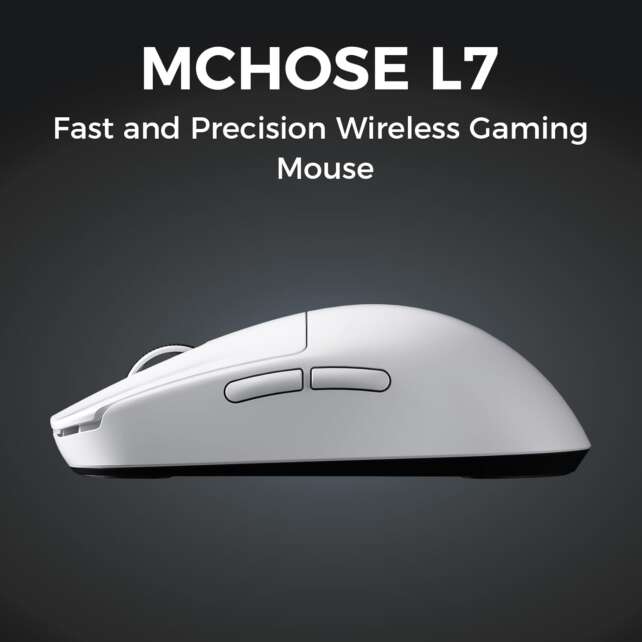
The MCHOSE L7 Ultra is a small, symmetrical, lightweight wireless gaming mouse built around a PixArt PAW3950 sensor, up to 42,000 DPI, 8,000 Hz wired and wireless polling, optical main switches, a TTC Gold wheel encoder, and MCHOSE’s M HUB configuration software. The current official compact listing identifies the selected White SKU as HW-L7-6KH and lists 115.62 × 60.61 × 36.04 mm dimensions, 39 g ±2 g weight, and a 250 mAh battery.
Independent RTINGS testing describes exceptionally low click and sensor latency and calls the L7 Ultra outstanding for FPS play. Its rearward hump and compact symmetrical shape suit claw and fingertip grips for small-to-medium hands. The main reasons to hesitate are an unusually important revision conflict—RTINGS’ later variant table reports 46 g ±2 g and 500 mAh for an L7 Ultra configuration—plus reported shell flex, mushy post-travel, lower-grade feet, a short warranty, and less-polished software.
The L7 Ultra’s value proposition is unusually strong: it combines a flagship-class PAW3950 sensor, 8K polling in both cable and 2.4 GHz wireless modes, optical switching, Bluetooth according to independent coverage, and a sub-50-gram compact body at an official current sale price of US$50.40 in the reviewed snapshot. MCHOSE markets the family around TOPSPEED low-latency wireless technology and M HUB web/app drivers, while its official page advertises up to 42,000 DPI, 750 IPS, and 50G acceleration for the PAW3950 tier.
The exact product identity matters here because MCHOSE’s official page is a family listing that changes content and price when the L7 Pro, L7 Ultra, L7 Pro+, or L7 Ultra+ selector is changed. The selected compact L7 Ultra page showed SKU HW-L7-6KH, a White finish, US$50.40 sale pricing, US$56 regular pricing, and the small 39 g ±2 g / 250 mAh configuration. The larger L7 Ultra+ is a distinct 119.6 × 62.9 × 38.1 mm, 48 g ±2 g / 500 mAh model and must not be used as a proxy for the requested L7 Ultra.
Description
The MCHOSE L7 Ultra is a small, symmetrical, lightweight wireless gaming mouse built around a PixArt PAW3950 sensor, up to 42,000 DPI, 8,000 Hz wired and wireless polling, optical main switches, a TTC Gold wheel encoder, and MCHOSE’s M HUB configuration software. The current official compact listing identifies the selected White SKU as HW-L7-6KH and lists 115.62 × 60.61 × 36.04 mm dimensions, 39 g ±2 g weight, and a 250 mAh battery.Independent RTINGS testing describes exceptionally low click and sensor latency and calls the L7 Ultra outstanding for FPS play. Its rearward hump and compact symmetrical shape suit claw and fingertip grips for small-to-medium hands. The main reasons to hesitate are an unusually important revision conflict—RTINGS’ later variant table reports 46 g ±2 g and 500 mAh for an L7 Ultra configuration—plus reported shell flex, mushy post-travel, lower-grade feet, a short warranty, and less-polished software.
Positives
- PAW3950 sensor with a manufacturer-rated ceiling of up to 42,000 DPI, 750 IPS, and 50G.
- Up to 8,000 Hz in both wired and wireless operation.
- Very low weight in the compact listing at 39 g ±2 g.
- RTINGS reports exceptionally low and consistent click latency and outstanding sensor performance.
- Small symmetrical shape works especially well for claw and fingertip grips with small-to-medium hands.
- Optical main switches, with a documented Omron/Kailh production-revision split.
- TTC Gold wheel encoder and two useful side buttons.
- Bluetooth support is reported by RTINGS and EloShapes in addition to 2.4 GHz and USB-C.
- M HUB web and app software supports DPI, polling, remapping, macros, and performance settings.
- Strong value at the current official US$50.40 sale price or approximately US$56 regular/review price.
- Compact holeless design avoids the exposed interior of many perforated ultralight mice.
Negatives
- MCHOSE and RTINGS publish conflicting L7 Ultra weight and battery figures, making the exact revision difficult to identify.
- RTINGS reports noticeable top-shell flex and slightly mushy switch post-travel.
- The small shape is not ideal for relaxed palm grip or very large hands.
- Only two side buttons are provided, so it is a poor substitute for a dedicated MMO mouse.
- The scroll wheel lacks free-scrolling and left/right tilt inputs.
- RTINGS reports that the feet do not glide as smoothly as higher-grade competing feet.
- The documented warranty is relatively short at 1 year.
- High polling can increase power use, and reliable runtime figures are difficult to state because the battery documentation varies by revision.
RTINGS’ later review update creates a second, credible specification set. Its variant table lists L7 Ultra in White, Black, and Blue with PAW3950, 500 mAh, and 46 g ±2 g advertised weight, while noting a component change from Omron optical switches in its tested sample to Kailh Black Green Dot optical switches in newer production. EloShapes instead reports the compact L7 family at approximately 39 g and US$56 for L7 Ultra. The responsible buying conclusion is not that one source is simply wrong; it is that L7 Ultra revisions/listings differ and the buyer should verify the exact seller SKU, battery, weight, and switch revision.
In use, the L7 Ultra is aimed at speed rather than ergonomic palm support. RTINGS describes a small symmetrical body with relatively flat sides and a rearward hump, while EloShapes compares its compact proportions with the Pulsar X2 Mini. Both independent sources describe strong practical performance, and RTINGS reports exceptionally low and consistent click latency and outstanding sensor performance.
The trade-offs are more visible in ownership than in a spec sheet. RTINGS reports noticeable flex when pressing the top of the thin shell, mushy switch post-travel, feet that glide less smoothly than higher-grade competitors, a one-year warranty, and a wheel without free-scrolling or left/right tilt. EloShapes found the shell solid in ordinary use with only slight flex under extreme pressure, so build impressions may depend on sample or revision.
Specifications
- Product type: Lightweight symmetrical wireless gaming mouse.
- Exact reviewed configuration: Compact MCHOSE L7 Ultra, White, official SKU HW-L7-6KH.
- Model boundary: Separate from L7, L7 Pro, L7 Pro+, and L7 Ultra+.
- Shape: Small symmetrical body with relatively flat sides and a medium rearward hump.
- Dimensions: 115.62 × 60.61 × 36.04 mm for the current compact L7 Pro/L7 Ultra listing.
- Weight: 39 g ±2 g on the current official compact listing; RTINGS reports 46 g ±2 g for a later/different L7 Ultra configuration.
- Shell: Holeless lightweight shell; official marketing describes a UV-coated surface, while independent coverage discusses a thin plastic shell and modest flex.
- Sensor: PixArt PAW3950.
- Maximum DPI: Up to 42,000 DPI for the PAW3950 Ultra tier.
- Maximum tracking speed: Up to 750 IPS, manufacturer/family specification.
- Maximum acceleration: Up to 50G, manufacturer/family specification.
- Main switches: Optical switches; MCHOSE’s current family page specifies Kailh optical switches rated at up to 150 million clicks, while RTINGS tested Omron optical switches and documents a later Kailh Black Green Dot revision.
- Scroll encoder: TTC Gold wheel encoder.
- Side buttons: Two side buttons in the compact design.
- Polling rate: Up to 8,000 Hz wired and 8,000 Hz wireless.
- Wireless connection: 2.4 GHz receiver using MCHOSE TOPSPEED wireless technology.
- Bluetooth: RTINGS and EloShapes report Bluetooth support; the official family extraction emphasizes 2.4 GHz/wired 8K and does not present an equally complete connectivity table. Verify the exact regional SKU/firmware.
- Wired connection: USB-C wired operation.
- Battery: 250 mAh on the currently selected compact official L7 Ultra listing; RTINGS’ later variant table reports 500 mAh for another L7 Ultra configuration.
- Battery runtime: No standardized runtime result was exposed in the accessible official, RTINGS, or EloShapes material.
- Wireless latency claim: MCHOSE advertises TOPSPEED latency of 0.125 ms; this is a manufacturer claim, not independent test data.
- Independent latency: RTINGS reports exceptionally low and consistent click latency but does not expose a single numeric result in the accessible review text.
- Software: M HUB web driver and downloadable/app driver.
- Software functions: DPI/CPI, polling, button remapping, macros, profiles, and performance/battery settings.
- Feet: Pure PTFE is advertised by MCHOSE; RTINGS says the tested feet are lower grade and glide less smoothly than higher-grade competitors, while EloShapes reports black PTFE that improves after break-in.
- Included accessories: Wireless receiver, USB-C cable, manual, and grip tape/feet are listed across the official and family materials; exact package contents should be checked against the selected SKU.
- Current official price snapshot: US$50.40 sale price, US$56.00 regular price for White SKU HW-L7-6KH on August 25, 2026.
- Independent review price context: EloShapes lists the L7 Ultra at US$56 in its review context.
- Launch-price context: The accessible independent material uses approximately US$56 as the L7 Ultra price context; a definitive original launch date or separate launch MSRP announcement was not verified.
- Availability: The MCHOSE official store showed the selected compact SKU available for ordering in the snapshot; RTINGS says MCHOSE returned the model to production by May 2026 after earlier availability notes. Retailer stock and color availability can change.
- Warranty evidence: RTINGS characterizes the warranty as a relatively short one year.
Detailed Product-Specific Analysis
Exact model and variant control
The L7 Ultra cannot be reviewed responsibly from a single family-level specification block. MCHOSE’s current listing groups the L7 Pro, L7 Ultra, L7 Pro+, and L7 Ultra+ under one product page, and the displayed SKU and price change with the selected option. The compact White L7 Ultra selected for this review is SKU HW-L7-6KH; it displayed US$50.40 sale pricing against US$56.00 regular pricing.
The official comparison text places compact L7 Pro and L7 Ultra at 115.62 × 60.61 × 36.04 mm and 39 g ±2 g, with a 250 mAh battery. The larger L7 Ultra+ is 119.6 × 62.9 × 38.1 mm, 48 g ±2 g, and 500 mAh. MCHOSE Australia’s page is primarily an Ultra+ listing and should not be used to assign 48 g or 500 mAh to the compact Ultra.
RTINGS’ variant table reports another L7 Ultra configuration at 46 g ±2 g with a 500 mAh battery and identifies a switch revision. This could reflect a later production run, an updated internal configuration, or a listing/model-label difference. The existence of a product-family page and multiple sources with materially different numbers makes the exact SKU and seller listing more important than the “L7 Ultra” name alone.
Shape, ergonomics, and grip
The L7 Ultra is a compact symmetrical mouse with a rearward hump. RTINGS describes relatively flat sides and says the body is best suited to claw or fingertip grips for small or medium-sized hands. EloShapes reports a similar compact profile with a moderate back hump, flat side curves, flat front flare, inward side curvature, and a centered sensor.
This shape is closer to a compact competitive mouse than to a palm-filling ergonomic design. EloShapes compares the general size with the Pulsar X2 Mini and reports that a 20.5 × 10.5 cm hand could fingertip grip it, while medium-to-small hands could claw grip it. Grip tape is included or listed in the family materials and can add friction and some rear/side support, but it cannot make a 115.62 mm body behave like a large ergonomic mouse.
The rearward hump can give claw users a useful contact point while leaving the front relatively open for fingertip control. That is favorable for rapid FPS corrections, but users who prefer a broad palm rest or a centered hump should try the shape—or compare measurements against a mouse they already like—before buying.
Sensor and competitive performance
The PAW3950 is the defining hardware upgrade over the standard L7 and L7 Pro. MCHOSE lists up to 42,000 DPI, 750 IPS, and 50G acceleration for the Ultra tier, while RTINGS and EloShapes identify the PAW3950 as the L7 Ultra’s sensor. These are high-end ceiling numbers; they indicate capability, not a requirement to use maximum DPI.
RTINGS’ performance verdict is unusually positive. It calls the mouse outstanding for FPS games, reports extremely low and consistent click latency, and describes sensor performance as outstanding and suitable for competitive play at any level. It also notes that 8,000 Hz is available in wired and wireless modes, which is more flexible than mice whose wireless receiver is limited to a lower rate.
EloShapes reports excellent practical performance and describes the L7 Ultra as a worthwhile upgrade for buyers who can spend more than the standard L7. Together, the sources support a strong performance conclusion even though they do not establish one universal latency number or independently validate every manufacturer ceiling specification.
8K polling is most useful when paired with a high-refresh display and a system that can process the extra reports. It can also increase system work and battery consumption compared with 1K or 2K. MCHOSE permits polling-rate adjustment through M HUB, and RTINGS says the software includes performance settings intended to optimize battery use.
Switches and click feel
The switch story is revision-sensitive. MCHOSE’s current family page specifies Kailh optical switches with a 150-million-click rating, while RTINGS identifies Omron optical switches in its tested sample and says newer units use Kailh Black Green Dot optical switches after a component change. EloShapes’ compact L7 Ultra review describes Omron optical switches with satisfying tactile response and moderate force.
Optical main switches are a good match for a competitive mouse because they avoid the traditional mechanical-contact problem associated with switch chatter and can deliver low actuation latency. The 150-million-click figure is a manufacturer lifespan claim, not a guarantee that every switch will reach that count under every use pattern. The exact tactile character may differ between Omron and Kailh production runs.
RTINGS reports slightly mushy post-travel, while EloShapes describes the optical switches as satisfying and responsive. These observations are not necessarily contradictory: the click can feel crisp at actuation while the return or bottoming behavior still feels less sharply controlled than on a more expensive mouse, and production revision or reviewer preference can affect the result.
Wheel, buttons, and productivity
The TTC Gold wheel encoder is listed for the L7 family and praised by EloShapes as balanced and moderately tactile. MCHOSE also emphasizes a TTC Gold encoder in its official copy. RTINGS’ independent limitation is that the wheel lacks free-scrolling and left/right tilt inputs, which makes the mouse less versatile for productivity than office-oriented models.
The compact body uses two side buttons. That is enough for general gaming, FPS actions, browser navigation, and a modest set of macros, but it is not a substitute for an MMO mouse with a large side grid. RTINGS says remapping and macros help for MMO/MOBA use but that the mouse has fewer additional buttons than dedicated MMO products.
Build quality, feet, and coating
MCHOSE markets the L7 family as a holeless lightweight design with a UV-coated surface. EloShapes reports a comfortable, grippy coating that remains reliable across humidity and temperature, good overall build quality, no rattle, and only slight flex under extreme pressure.
RTINGS is more critical. It reports a thin plastic shell with noticeable flex when pressed from the top and minor build-quality issues, along with lower-grade feet that do not glide as smoothly as higher-quality pure PTFE feet on competing mice. The difference between the two reviews is worth preserving: normal-use rigidity may be good, but a pressure test can still reveal flex.
The official page advertises pure PTFE skates, while RTINGS qualifies the actual tested feet as lower grade and EloShapes says its black PTFE feet became fast and smooth after a short break-in. Buyers should expect a usable glide but not assume the marketing label guarantees the same feel as a premium aftermarket skate set.
Wireless, Bluetooth, and software
MCHOSE’s TOPSPEED system is advertised for low-latency 2.4 GHz wireless operation, and the family page supports up to 8K wireless polling. RTINGS and EloShapes additionally report Bluetooth, making the L7 Ultra more flexible for general work or secondary devices than a 2.4 GHz-only mouse. Because the official page’s accessible family copy does not expose a complete connectivity table as clearly as the independent reviews, buyers should verify Bluetooth on the precise regional SKU.
USB-C wired operation is documented, and MCHOSE advertises 8K wired as well as wireless. A cable connection is useful for charging, troubleshooting, firmware work, or minimizing wireless variables in a tournament setup.
M HUB is available as a web driver and downloadable/app driver. RTINGS says it supports remapping, macros, and performance settings, while MCHOSE says users can adjust DPI and polling and program macros. The software is functional, but the long-term polish, device ecosystem, and support maturity are not as established as those of the major peripheral brands.
Battery and revision risk
Battery capacity is one of the most consequential conflicts. The currently selected compact official L7 Ultra lists 250 mAh, while RTINGS’ later variant table lists 500 mAh and 46 g ±2 g. A larger battery can explain part of the weight difference, but the sources do not establish a single universal production timeline or an exact battery/SKU map for every color.
No accessible source used here provides a standardized runtime result for the exact HW-L7-6KH configuration. Capacity is not runtime: polling rate, Bluetooth versus 2.4 GHz, sleep behavior, firmware, RGB or indicator behavior, and battery health all change hours. The review therefore avoids translating 250 mAh or 500 mAh into an invented number of days.
Users who plan to run 8K wirelessly for long sessions should regard the battery as a check-before-buying item. M HUB’s polling and performance settings may allow a useful compromise, and wired USB-C operation remains available if the battery is low.
Accessories and regional availability
The official family page describes a wireless receiver, optical switches, TTC Gold encoder, Pure PTFE skates, and M HUB support. The wider L7 materials and retailer pages show USB-C cable, manual, grip tape, and receiver accessories, but package contents can vary by selected model and seller. Confirm the included receiver and any 8K-dongle requirement before purchase.
MCHOSE’s official store showed the selected White compact L7 Ultra available to order at US$50.40 in the August 25, 2026 snapshot. RTINGS’ May 2026 update says MCHOSE returned the mouse to production after earlier availability notes, which indicates that stock history has not been entirely stable. The existence of a current store listing is evidence of availability at the snapshot time, not a promise of permanent stock or identical regional fulfillment.
MCHOSE Australia’s page identifies authorized-partner availability for the larger L7 Ultra+ and carries different dimensions, battery, weight, and switch details. It is useful for regional distribution context but not as the specification authority for the compact L7 Ultra.
Price, release timing, and value
The exact selected official listing showed US$50.40 on sale, with US$56.00 as the regular price. EloShapes also uses US$56 as the L7 Ultra price context, while older or different L7 variants are listed at lower prices. The official price is a dated snapshot and can change with promotions, region, color, shipping, tax, and bundle contents.
RTINGS’ review page is dated July 9, 2025 and contains updates through June 2026, including the February 2026 component note and May 2026 production update. Those dates establish that the model had independent coverage by July 2025 and that its specifications/availability were revisited later, but the accessible sources do not establish a definitive original launch day or a separately documented launch MSRP.
At roughly US$50–56, the L7 Ultra is compelling for users who want a compact shell, PAW3950 tracking, 8K wireless, optical clicks, Bluetooth, and configurable software. The value is less clear for users who need a fully documented battery runtime, premium feet, a long warranty, a large palm-support shape, or a mature first-party ecosystem.
Frequently Asked Questions
Is the MCHOSE L7 Ultra good for FPS games?
Yes. RTINGS rates it outstanding for FPS gaming, citing its very low weight, exceptionally low click latency, outstanding sensor performance, and support for up to 8,000 Hz polling in wired and wireless modes.
What hand size is the L7 Ultra best for?
It is best suited to small or medium-sized hands using claw or fingertip grip. Larger-handed users may still prefer it for fingertip grip, but its compact 115.62 × 60.61 × 36.04 mm body is not designed as a large palm-support mouse.
Is the L7 Ultra symmetrical?
The body is broadly symmetrical in shape, with a rear-positioned hump and inward-curved sides, but its two side buttons make the overall design functionally right-handed.
Does it really support 8,000 Hz wirelessly?
MCHOSE advertises up to 8,000 Hz in both wired and wireless modes, and RTINGS reports that the L7 Ultra supports the maximum polling rate in both connection types. The practical benefit depends on the game, system, display refresh rate, and the user’s sensitivity to latency.
What sensor does the L7 Ultra use?
The L7 Ultra uses the PixArt PAW3950 sensor, with official and independent sources listing up to 42,000 DPI, 750 IPS, and 50G acceleration.
What switches does it use?
This depends on the production revision. MCHOSE’s current page advertises Kailh optical switches rated for up to 150 million clicks, while RTINGS tested an Omron optical configuration and notes that newer production units may use Kailh Black Green Dot optical switches. Check the exact seller listing before buying.
How much does the L7 Ultra weigh?
The current MCHOSE L7-series page lists the compact L7 Ultra at 39 g ±2 g, while RTINGS lists a later L7 Ultra configuration at 46 g ±2 g. Because the sources disagree, verify the weight for the exact revision being sold.
How large is its battery?
The current official page lists 250 mAh for the compact L7 Ultra, while RTINGS lists a 500 mAh battery for a later L7 Ultra configuration. These may represent different revisions or a product-page inconsistency, so do not assume one capacity applies to every unit.
Is it suitable for MMO games?
It can handle MMO or MOBA play through remapping and macros, but it has only two side buttons. A dedicated MMO mouse with a larger side-button array is much better for games that require many simultaneous bindings.
Is the L7 Ultra good for office work?
It can be useful for general work because it supports Bluetooth and button remapping, but the wheel lacks free-scrolling and left/right tilt inputs, and the small shape may not suit a relaxed palm grip.
Does it include grip tape?
MCHOSE’s official family page says the L7 series includes grip tape for the sides, primary buttons, and rear area. Confirm the exact package contents for the selected SKU.
What does it cost?
The selected official White HW-L7-6KH listing showed US$50.40 on sale against a US$56.00 regular price on August 25, 2026. EloShapes also uses US$56 as its L7 Ultra price context. Regional shipping, tax, promotions, and bundles can change the final cost.
When did the L7 Ultra launch?
RTINGS has a review dated July 9, 2025 and updates through 2026, establishing independent coverage by that time. The accessible sources do not establish a definitive original launch day or a separately documented launch MSRP announcement.
Is the MCHOSE L7 Ultra still available?
The official MCHOSE store showed the selected compact White SKU available for ordering in the August 25, 2026 snapshot. RTINGS’ May 2026 update says MCHOSE returned the model to production after earlier availability notes. Stock and color selection remain region- and seller-dependent.
What is the larger alternative within the L7 family?
The L7 Ultra+ is the larger alternative, but it is a separate model with different dimensions, weight, battery, and potentially different switch configuration. Do not buy it expecting the compact L7 Ultra’s 39 g/250 mAh specification.
Important Caveats
The most important caveat is the L7 Ultra revision and family-listing conflict. The current selected official compact SKU HW-L7-6KH shows 39 g ±2 g and 250 mAh, while RTINGS’ later variant table shows an L7 Ultra at 46 g ±2 g and 500 mAh. The review reports both rather than fabricating a single universal number.
The L7 Ultra+ is not the L7 Ultra. MCHOSE Australia’s page describes the Ultra+ at 119.6 × 62.9 × 38.1 mm, 48 g ±2 g, 500 mAh, and a Kailh Black Green Dot switch configuration. Those are Ultra+ data and must not be used for the compact L7 Ultra.
The switch model is also revision-sensitive. RTINGS tested Omron optical switches and says newer production uses Kailh Black Green Dot optical switches, while the current MCHOSE family page says Kailh optical switches with a 150-million-click rating. The click feel and actuation character may vary by production run.
The 0.125 ms wireless-latency number is a manufacturer claim. RTINGS independently reports exceptionally low and consistent click latency but does not expose that same numeric value in the accessible page text. The two statements should not be presented as identical test results.
The 39 g value is not a guaranteed measured weight for every unit. MCHOSE writes 39 g ±2 g for the compact listing, EloShapes reports approximately 39 g, and RTINGS reports a heavier configuration. Treat the official tolerance and revision difference as meaningful.
The battery runtime is unverified for the exact compact SKU in the accessible sources. The review reports capacity differences but does not convert them to hours. Buyers should confirm the seller’s battery claim, firmware behavior, and return policy if runtime is a priority.
The official page is dynamic. Its visible SKU, price, and displayed variant change when the L7 Pro, L7 Ultra, L7 Pro+, or L7 Ultra+ selector changes. Always capture the selected variant/SKU at checkout.
The Bluetooth claim comes from independent coverage. RTINGS and EloShapes report Bluetooth, but the official family copy accessed here emphasizes TOPSPEED 2.4 GHz and wired 8K more clearly. Confirm the feature on the exact regional listing rather than relying on a generic L7 family description.
The feet and shell assessments differ by reviewer. RTINGS reports top-shell flex and lower-grade feet, while EloShapes describes strong ordinary-use build quality and break-in-improving PTFE glide. This is best treated as a minor quality-control/sample/revision caveat, not as proof that every unit is defective.
The launch date and launch MSRP were not definitively verified. RTINGS’ July 2025 review date and later 2026 updates establish coverage and subsequent changes, but not the original announcement date.
Verdict
The MCHOSE L7 Ultra is one of the strongest performance-per-dollar compact gaming mice in this group. The selected compact SKU combines a PAW3950 sensor, 8K wired and wireless polling, optical main switches, a TTC Gold encoder, M HUB configuration, and a reported Bluetooth mode in a 39 g ±2 g body. RTINGS’ independent results support the central promise: exceptionally low click latency, outstanding sensor performance, and excellent FPS suitability.
Its caution label is not raw performance but product-version discipline. The official compact listing says 39 g and 250 mAh, while RTINGS documents a later/different 46 g and 500 mAh configuration with a newer switch revision. The L7 Ultra+ is larger again, and retailer pages can present Ultra+ specifications under a broad L7 title. Buyers should save the exact SKU and verify weight, battery, switches, Bluetooth, included receiver, and warranty before ordering.
For small-to-medium-handed claw or fingertip players who want flagship-class sensor and polling performance at roughly US$50–56, the compact MCHOSE L7 Ultra earns 4.5/5 stars. It is less ideal for large-hand palm users, buyers who demand a long warranty and polished software, or anyone unwilling to navigate revision and availability ambiguity.
