

The Pulsar X2 v3 Medium is a 52 g-class symmetrical wireless gaming mouse with a low hump, wide waist, optical main switches, Pulsar’s XS-1 sensor, and support for up to 8,000 Hz polling. Its US$99.95 official price is competitive, but the headline 8K mode requires purchasing a separate dongle rather than using a receiver included with the standard package.
Its best fit is a claw or fingertip player who wants a compact-to-medium symmetrical shell and very low weight without holes. The main limitations are incomplete official battery disclosure, limited direct independent coverage, a source-reported short high-performance runtime, and the extra cost of the 8K dongle.
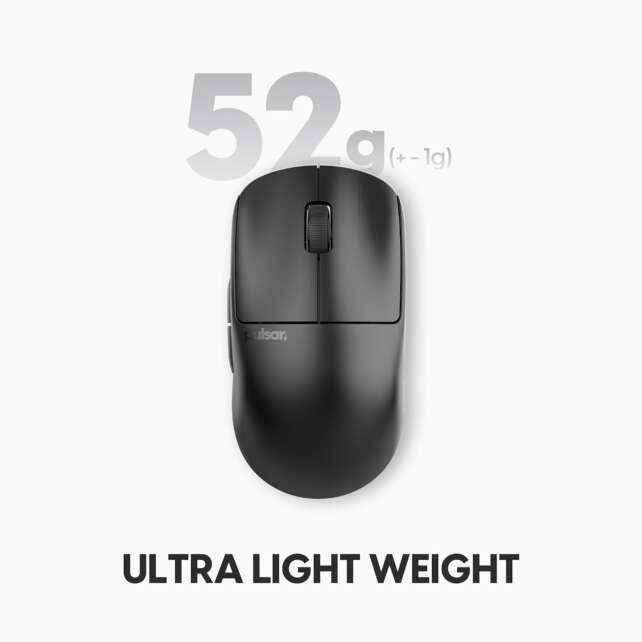
The X2 v3 Medium is the conventional, standard-size member of Pulsar’s third-generation X2 line. Pulsar lists a 120.4 × 63 × 38 mm body and a 52 g ±1 g weight without the cable, while an independent Nookyyy listing reports 53.1 g for its reviewed unit. The shape is symmetrical, low-hump, and wide-waisted, and Pulsar specifically recommends it for claw and fingertip grips.
The sensor platform is strong on paper and unusually modern for this price tier. Pulsar’s XS-1 sensor is specified at 32,000 DPI, 750 IPS, and 50 G acceleration, with a 32-bit ARM processor. Nookyyy identifies the XS-1 as a PixArt PAW3950 implementation and lists selectable polling from 125 Hz through 8,000 Hz. Because Pulsar’s public product page brands the sensor XS-1 without exposing the underlying PixArt model in its accessible specifications, the PAW3950 identification should be attributed to the independent listing rather than treated as a first-party nomenclature claim.
Description
The Pulsar X2 v3 Medium is a 52 g-class symmetrical wireless gaming mouse with a low hump, wide waist, optical main switches, Pulsar’s XS-1 sensor, and support for up to 8,000 Hz polling. Its US$99.95 official price is competitive, but the headline 8K mode requires purchasing a separate dongle rather than using a receiver included with the standard package.Its best fit is a claw or fingertip player who wants a compact-to-medium symmetrical shell and very low weight without holes. The main limitations are incomplete official battery disclosure, limited direct independent coverage, a source-reported short high-performance runtime, and the extra cost of the 8K dongle.
Positives
- The standard medium’s 120.4 × 63 × 38 mm symmetrical shell is well targeted at claw and fingertip users.
- A 52 g ±1 g official weight claim, with a 53.1 g independent listing, makes it highly mobile without a perforated shell.
- The XS-1 sensor provides 32,000 DPI, 750 IPS, and 50 G acceleration.
- Optical main switches are intended to reduce conventional double-click wear risk.
- Adjustable 0.7/1/2 mm LOD and Motion Sync provide useful competitive tuning.
- Pulsar Blue Encoder and a superflex paracord cable are stronger appointments than the price alone suggests.
- US$99.95 is reasonable for the standard medium with 1K wireless included.
- Windows software and wired operation on macOS/Linux broaden the platform baseline, subject to software-version support.
Negatives
- The 8K dongle is not included and must be purchased separately.
- Pulsar’s accessible standard-medium page omits battery capacity and runtime, leaving the buyer to rely on less formal independent data.
- Nookyyy’s approximately 12-hour “best mode” result suggests high-polling endurance may be short.
- Direct independent testing of the standard medium is limited; much of the detailed family evidence comes from the different X2 v3 eS Mini.
- Main-switch naming is not fully consistent across sources: Pulsar says optical, while Nookyyy names RAESHA SMT Optical 80M.
- Bluetooth is not listed in the opened exact-model specifications.
- The low-hump wide-waist shape may be less suitable for users who want a tall palm-supporting ergonomic shell.
- The T1 Edition’s two-year warranty cannot automatically be assumed for the standard Black/White listing.
The standard package is not an out-of-the-box 8K bundle. It includes the mouse, wireless receiver adapter, wireless receiver, and USB-C cable, while Pulsar states that an 8K dongle must be purchased separately. The normal included receiver is intended for the standard 1,000 Hz mode; 8,000 Hz is an optional upgrade.
The X2 v3 uses optical main switches and a Pulsar Blue Encoder wheel. Pulsar describes its optical implementation as fast and resistant to conventional double-click wear, while Nookyyy names its sample’s main switches as RAESHA SMT Optical 80M and lists a 0–20 ms debounce range. This is useful model-specific evidence, but switch naming should still be treated as sample or revision information unless the purchase page confirms it for the exact unit.
Battery information is unusually incomplete in the official product material. Pulsar does not publish a capacity or runtime in the accessible standard-medium specifications, whereas Nookyyy reports 300 mAh and approximately 12 hours in its “best” mode, defined as the most power-intensive configuration. That estimate is not a universal endurance promise; it is a source-specific result that likely reflects high polling and performance wireless settings.
At US$99.95, the X2 v3 Medium is attractive if the buyer is satisfied with 1,000 Hz and does not need Bluetooth. It is less compelling as an 8K purchase because the dongle is extra, and its value must be judged against models that include high-polling receivers. The standard medium was listed as available by December 11, 2024 in Nookyyy’s product record, but the opened sources do not establish a separate official global launch announcement or a different launch MSRP.
“Up to 8K Polling Rate (Dongle purchase required for 8K Polling).” — Pulsar’s official X2 v3 product page.
Specifications
- Exact model: Pulsar X2 v3 Medium Wireless Gaming Mouse; standard medium size, not Mini, X2H, eS, T1 Edition, or CrazyLight.
- Dimensions: 120.4 mm long × 63 mm wide × 38 mm high according to Pulsar; Nookyyy lists 120.4 × 63.2 × 38.1 mm.
- Weight: 52 g ±1 g without cable according to Pulsar; Nookyyy reports 53.1 g for its unit.
- Shape: Symmetrical/ambidextrous shell with a wide waist and low hump.
- Grip guidance: Recommended for claw and fingertip grips; family-adjacent eS Mini coverage also emphasizes rear-hump claw/fingertip fit, but that is not a direct medium-model measurement.
- Sensor: Pulsar XS-1; Nookyyy identifies its standard-medium listing as PixArt PAW3950.
- Maximum sensitivity: 32,000 DPI/CPI.
- Tracking specification: 750 IPS and 50 G acceleration.
- Processor: 32-bit ARM processor on the official product page; Nookyyy lists a Nordic nRF52840 MCU.
- Polling: 1,000 Hz / 1 ms standard; up to 8,000 Hz with a separately purchased Pulsar 8K Wireless Gaming Dongle. Nookyyy lists 125, 250, 500, 1,000, 2,000, 4,000, and 8,000 Hz choices.
- Main switches: Fast optical switches according to Pulsar; Nookyyy lists RAESHA SMT Optical 80M for its standard-medium entry.
- Switch behavior: Optical design marketed as double-click resistant; Nookyyy lists 0–20 ms debounce adjustment.
- Scroll wheel: Pulsar Blue Encoder; Pulsar describes tactile rotation, quiet operation, and dust resistance.
- Lift-off distance: 0.7 mm, 1 mm, or 2 mm.
- Motion Sync: Adjustable through Pulsar software; Pulsar says it can add less than 1 ms of motion delay, while Nookyyy explains the usual smoothness-versus-delay trade-off.
- Wireless connection: 2.4 GHz wireless receiver.
- Wired connection: USB-C cable and wired operation through the included superflex paracord cable.
- Bluetooth: Not listed in the opened official or retailer specifications; treat the standard X2 v3 Medium as 2.4 GHz plus wired rather than Bluetooth tri-mode.
- Battery: Pulsar’s accessible standard-medium product page does not state capacity; Nookyyy reports 300 mAh.
- Battery life: Nookyyy reports approximately 12 hours in its “best” high-power mode; no official runtime is published in the accessible product specification.
- Charging: USB Type-C.
- Software: Pulsar Fusion/Fusion2 software for DPI, remapping, macros, Motion Sync, and related sensor settings.
- Software operating system: Pulsar lists Windows 7 or later for software and says wired USB operation is available with Windows, macOS, and Linux.
- Included package: Mouse, wireless receiver adapter, wireless receiver, and USB-C cable; the 8K dongle is not included with the standard package.
- Cable: Pulsar Superflex paracord, listed by Nookyyy as 1.8 m.
- Feet: Default PTFE skates; the official standard page does not advertise the replacement-foot arrangement associated with some other Pulsar models.
- Colors: Black and White on the official standard page; Nookyyy lists the same two colors.
- Current official price snapshot: US$99.95 for the standard X2 v3 Medium as shown on Pulsar’s official store on August 25, 2026.
- Launch/availability timing: Nookyyy lists availability since December 11, 2024. This is not an official launch announcement, and a distinct launch MSRP was not verified.
- T1 Edition distinction: MaxGaming lists a separate Black/Red T1 Edition, manufacturer article number PX232T1, with a two-year warranty in that listing. Do not automatically transfer that edition’s finish or warranty to the standard Black/White model.
Detailed Product-Specific Analysis
Exact model and size boundary
“Pulsar X2 v3” is a family name that now covers several size and feature combinations. The standard product page researched here is explicitly the X2 v3 Medium, with a 120.4 mm length, 63 mm width, 38 mm height, and 52 g ±1 g official weight. The X2 v3 Mini is shorter and lighter, X2H v3 has a different taller shape, and X2 v3 eS models add features such as an OLED display and an included 8K dongle. Those products should not be used to fill gaps in the standard medium’s specifications.
The T1 Edition is another boundary worth preserving. MaxGaming identifies it as a Black/Red collaboration-style product with manufacturer article number PX232T1. Its functional specifications overlap with the standard medium, but edition-specific finish, warranty, and regional package details may differ. The review’s price and package assessment therefore target Pulsar’s standard Black/White Medium listing rather than the T1 Edition.
Shape and hand fit
Pulsar describes the medium shell as symmetrical with a wide waist and low hump, and recommends it for claw and fingertip grips. Nookyyy’s independent medium entry agrees with the ambidextrous shape and 120 mm-class dimensions. The shape should be most comfortable for players who want a relatively low rear profile that supports the back of the hand without forcing a full palm grip.
The design is less obviously suited to a deeply planted palm grip than a taller ergonomic mouse. The 38 mm height and rear-biased hump provide some support, but the wide waist and low-hump geometry prioritize fingertip freedom and claw control. Hand size and preferred contact points matter more than the “Medium” label, so buyers should compare the dimensions with their current mouse rather than assuming a universal fit.
The eS Mini review is useful only as family-adjacent context. EloShapes describes that smaller model as having a flat front flare, flat sides, low button height, and rear-positioned hump, with claw particularly natural for small and medium hands. Those observations support the X2 family’s design language but are not direct measurements of the standard medium’s coating, shell, or button feel.
Weight, construction, and surface
Pulsar’s official 52 g ±1 g figure is specified without the cable. Nookyyy reports 53.1 g for its medium listing, which is close enough to be treated as a normal measurement difference rather than a different size. The mouse is light without relying on visible holes, which is desirable for users who prefer a conventional closed shell.
Direct independent build testing of the standard medium is limited in the accessible sources. EloShapes found the related eS Mini solid, with no flex, creaking, or rattle, but the eS Mini contains different internal hardware and is a smaller model. That evidence supports cautious optimism about Pulsar’s construction approach, not a claim that every standard X2 v3 Medium unit has identical rigidity.
Nookyyy describes its medium sample as matte and solid-colored and lists default PTFE skates. The official page does not provide a detailed coating or replacement-skate specification for the standard medium, so the buyer should not assume the same premium coating, feet, or accessory set as an eS model or another Pulsar release.
Sensor and motion features
The XS-1 platform gives the X2 v3 Medium a competitive specification set: 32,000 DPI, 750 IPS, and 50 G acceleration. Nookyyy identifies the XS-1 as a PixArt PAW3950 implementation, while Pulsar itself uses the XS-1 branding in the standard product page. This distinction is important because “XS-1” is Pulsar’s product-facing name and “PAW3950” is the independent underlying-sensor identification.
The mouse provides three lift-off-distance choices: 0.7 mm, 1 mm, and 2 mm. A low setting is useful for players who frequently lift and reposition the mouse, while a higher setting can be preferable on surfaces or play styles where tracking through a small lift is desired. Nookyyy also lists Motion Sync as adjustable; Pulsar says Motion Sync synchronizes sensor signals with PC polling intervals but can introduce less than 1 ms of motion delay.
Motion Sync is not automatically a universal upgrade. Nookyyy explains that synchronization may improve consistency at the cost of waiting for the next polling event, so competitive players should compare enabled and disabled behavior with their own sensitivity, polling rate, and display rather than activating it solely because it sounds more precise.
Polling and responsiveness
The included receiver supports the standard 1,000 Hz / 1 ms mode. The mouse is 8K-ready, but Pulsar explicitly requires the separately purchased 8K Wireless Gaming Dongle for the higher rate. This is a material package distinction: the standard mouse’s official US$99.95 price does not mean the buyer receives a complete 8K kit.
Nookyyy lists polling choices from 125 Hz to 8,000 Hz and reports 1 ms click latency relative to a 0 ms base for the Zaunkönig Mk2 and Razer Viper 8K. Because its extracted page does not describe a complete test methodology, this should be treated as a useful independent rating rather than a directly comparable controlled latency measurement against every other mouse.
The practical benefit of 8K depends on the game, frame rate, display refresh, and system load. At 1,000 Hz, the mouse already reports every millisecond; higher rates can reduce the interval between reports but also increase power consumption and may require a compatible high-refresh setup. For many users, the standard receiver and 1K mode will deliver the better balance of battery life, compatibility, and simplicity.
Switches and wheel
Pulsar says the X2 v3 uses fast optical switches designed to prevent conventional double-click failures. Nookyyy’s standard-medium entry identifies RAESHA SMT Optical 80M switches and an adjustable 0–20 ms debounce range. The difference between the official generic description and the named independent switch entry may reflect revision, sample, or the level of detail provided by each source. Buyers should confirm the exact switch implementation on the product page or packaging if click feel is a deciding factor.
The Pulsar Blue Encoder wheel is a notable part of the specification. Pulsar describes it as tactile, quiet, and dust-resistant, and EloShapes found the same encoder concept on the related eS Mini to balance smoothness and tactility. That family observation is encouraging, but wheel feel can vary by sample and the eS Mini’s aluminum wheel is not necessarily identical to the standard medium’s implementation.
Battery and charging
Battery life is the biggest documentation weakness of the standard X2 v3 Medium. Pulsar’s accessible product page specifies wireless functionality and the optional 8K dongle but does not publish battery capacity or runtime. Nookyyy reports a 300 mAh battery and 12 hours in “best” mode, where its note defines best as a high-power combination of maximum polling, best 2.4 GHz mode, best sensor mode, and RGB if available.
The Nookyyy figure should therefore be read as a high-performance estimate, not as an everyday 1K-runtime promise. A mouse can last longer when used at 1,000 Hz, with conservative sensor settings and ordinary sleep behavior, but the opened sources do not provide a standardized long-runtime test for the standard medium. It would be inaccurate to borrow the battery figure from the X2 v3 eS Mini or another X2 model simply because the family name is similar.
The separate dongle creates a second battery-related decision. If the buyer adds 8K, the higher report rate will generally increase power use and may make the short high-performance estimate more relevant. If endurance matters, the standard receiver at 1K is the sensible starting point.
Software and platform support
Pulsar Fusion software provides detailed configuration, including 10-unit DPI steps, key reassignment, macros, Motion Sync, and sensor controls. Nookyyy lists Pulsar Fusion2 for the standard medium, while Pulsar’s product page uses the Fusion Software name. This naming difference should be treated as a software-version distinction rather than evidence of different mouse hardware.
The official documentation lists Windows 7 or later as the software requirement and says wired USB use is available with Windows, macOS, and Linux. That means the mouse can be physically used outside Windows, but the complete configuration experience may depend on Pulsar’s current software support. The opened sources do not verify a separate macOS/Linux feature matrix or Bluetooth pairing mode.
Connectivity and accessories
The standard package includes a wireless receiver, receiver adapter, and USB-C cable. The 8K dongle is a separate purchase, unlike the X2 v3 eS Mini package described by EloShapes, which includes its high-speed receiver. The distinction affects both out-of-box performance and total cost.
Pulsar’s superflex paracord cable is intended to reduce drag in wired use, and Nookyyy lists it at 1.8 m. The standard medium does not list Bluetooth in the opened official, Nookyyy, or MaxGaming specifications, so it should be treated as a 2.4 GHz wireless and wired mouse rather than as a multi-device tri-mode product.
Price, timing, and value
The official Pulsar store showed US$99.95 for the X2 v3 Medium on August 25, 2026. The page offered Black and White choices, Add to Cart controls, and an Amazon link. It did not present a clean stock quantity in the extracted content, so the accurate availability statement is that the product was actively listed for purchase, not that every regional warehouse was guaranteed to have stock.
Nookyyy records the model as available since December 11, 2024 and lists US$99.95 MSRP. This is the clearest opened-source timing evidence, but it is not an official launch announcement and should not be presented as a confirmed worldwide launch date. The accessible sources also do not prove a different launch MSRP.
The value calculation is straightforward. At US$99.95, the mouse offers the medium X2 shape, 52 g-class weight, XS-1/PAW3950-class sensor, optical clicks, and 1K wireless capability. The buyer must add the cost of the separate 8K dongle to compare it with a complete 8K package, and must also account for regional shipping, VAT, import duties, and warranty handling.
Frequently Asked Questions
Is the Pulsar X2 v3 the same as the X2H v3 or X2 v3 Mini?
No. The X2 v3 Medium reviewed here is 120.4 × 63 × 38 mm and 52 g ±1 g without the cable. The X2 v3 Mini is smaller, and the X2H v3 uses a different taller shape. The eS models also add different hardware and accessories. Their specifications should not be substituted for the standard medium.
Does the standard Pulsar X2 v3 Medium include 8K polling out of the box?
No. Pulsar states that the mouse is up to 8K-ready, but the 8K Wireless Gaming Dongle must be purchased separately. The standard package includes the ordinary wireless receiver, receiver adapter, and USB-C cable.
What is the standard X2 v3 Medium’s polling range?
The official page specifies 1,000 Hz as standard and up to 8,000 Hz with the separate dongle. Nookyyy lists 125, 250, 500, 1,000, 2,000, 4,000, and 8,000 Hz settings for its standard-medium entry.
What sensor does the Pulsar X2 v3 use?
Pulsar calls it the XS-1 flagship sensor and lists 32,000 DPI, 750 IPS, and 50 G acceleration. Nookyyy identifies the XS-1 in its standard-medium listing as PixArt PAW3950. The former is Pulsar’s product-facing name; the latter is the independent underlying-sensor identification.
What switches are fitted?
Pulsar describes the main switches as fast optical switches. Nookyyy names its standard-medium entry RAESHA SMT Optical 80M and lists 0–20 ms debounce adjustment. Because the official page does not expose the same detailed switch name, confirm the exact listing or revision if switch feel is important.
How long does the battery last?
The official standard-medium product page does not publish capacity or runtime in its accessible specifications. Nookyyy reports a 300 mAh battery and approximately 12 hours in its “best” high-power mode. That is not a universal everyday figure; expect runtime to depend heavily on polling rate, sensor mode, wireless mode, and sleep settings.
Does the X2 v3 Medium support Bluetooth?
Bluetooth was not listed in the opened official or retailer specifications. Treat the mouse as 2.4 GHz wireless plus wired USB unless Pulsar confirms Bluetooth for the exact SKU.
Which grips suit the X2 v3 Medium?
Pulsar recommends claw and fingertip grips for its symmetrical, low-hump, wide-waist design. The shape may also work for some relaxed-claw or smaller-hand palm users, but people seeking a tall ergonomic palm-support shell should compare dimensions before purchase.
What software does it use?
Pulsar identifies Fusion software for DPI adjustment in 10-unit increments, key reassignment, macros, and Motion Sync. Nookyyy lists Fusion2 for its standard-medium record, likely reflecting a software-version label. The official operating-system requirement is Windows 7 or later, while wired USB use is listed for Windows, macOS, and Linux.
Is the US$99.95 price good?
It is good for the standard 1K package if the shape fits and the buyer does not need Bluetooth or long high-polling endurance. It is less aggressive as an 8K proposition because the separate dongle increases total cost. Regional tax, shipping, import, and warranty terms can further change the final value.
Important Caveats
The exact product identity matters. “X2 v3” can refer to medium, Mini, eS, or other related products, and the X2H v3 is a different shape family. This review intentionally uses the standard X2 v3 Medium page and its 120.4 × 63 × 38 mm, 52 g-class specifications. The T1 Edition is recorded separately because its finish and warranty listing differ.
Battery data is the most important evidence limitation. Pulsar’s accessible official standard-medium page omits capacity and runtime, while Nookyyy reports 300 mAh and 12 hours in a high-power “best” mode. Do not quote 12 hours as a universal runtime, and do not borrow battery figures from the Mini, eS, X2H, or older X2.
Independent evidence is also uneven. Nookyyy provides the most direct standard-medium entry, including weight, battery, switch name, and a 1 ms click-latency value, but its extracted page does not fully describe the test method. EloShapes provides useful hands-on context for the related eS Mini, yet that model is smaller, more feature-rich, and packaged with an 8K dongle. These sources support cautious judgment, not a claim of complete standardized laboratory coverage.
The 8K capability is an optional upgrade, not an included feature of the standard package. The US$99.95 price should therefore be compared with 1K-equipped mice on an apples-to-apples basis, or with complete 8K packages only after adding the separate Pulsar dongle.
The official store page was actively listed with Add to Cart controls and an Amazon link at the research snapshot, but extracted content did not show a definitive stock quantity for every region. Nookyyy’s December 11, 2024 “available since” date is useful timing evidence, not a confirmed worldwide launch day.
Verdict
The Pulsar X2 v3 Medium is a four-star lightweight esports mouse with a particularly coherent 1K value proposition. Its low-hump symmetrical shape, 52 g-class body, optical switches, XS-1/PAW3950-class sensor platform, adjustable LOD, Blue Encoder, and flexible cable make it a capable choice for claw and fingertip players.
The recommendation is strongest when the buyer wants the standard medium shape and is content to use 1,000 Hz. It is less decisive for buyers who want a complete 8K package, Bluetooth, long high-polling battery life, or extensive direct third-party measurements. The separate dongle and incomplete official battery specification keep it from a five-star value rating, but at US$99.95 it remains a strong, sensible choice in the lightweight wireless category.
Final rating: 4.0/5 stars.
