

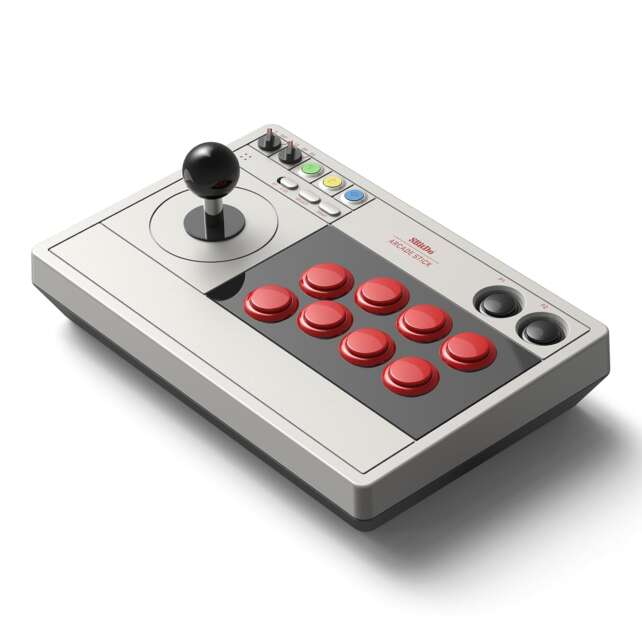
The 8BitDo Retro Wireless Arcade Fight Stick is best understood as a retailer-named retro edition of 8BitDo’s original Arcade Stick for Nintendo Switch and Windows PC. It combines an eight-way joystick and arcade buttons with Bluetooth, 2.4 GHz wireless, USB-C wired play, a 1000 mAh battery, two macro buttons, turbo, joystick-function switching, mode-dependent button lighting, and Ultimate Software. Independent coverage describes a heavy, stable body and usable controls, while current reporting says firmware added Nintendo Switch 2 compatibility to the Arcade Stick family.
It is not a native PlayStation or Xbox fight stick, and it should not be confused with the 8BitDo Arcade Stick for Xbox or with a separate new-generation retro controller. Gamepadla’s available test favors wired and 2.4 GHz connections over Bluetooth, and independent reviewers find the stock joystick less refined than premium parts and deeper modding less effortless than “ultra-moddable” marketing suggests.
Overall rating: 4/5 stars. It is a strong value-oriented choice for Switch/Switch 2 and PC players who want a retro aesthetic and wireless flexibility, especially near the $89.99 official price. The model-name overlap is the main buying hazard.
The requested product name points to a real retail listing, but not to a neatly isolated official SKU. Best Buy lists a gray Retro Arcade Fight Stick for Nintendo Switch & Windows with the same Ultimate Software, macro, turbo, dynamic-layout, three-connection, receiver-storage, and modding language as 8BitDo’s official Arcade Stick page. Galleon uses the more specific wording Retro Wireless Arcade Fight Stick for Switch/Switch 2, PC Windows and repeats the same eight-way joystick, macro, battery, and connectivity specifications.
Description
The 8BitDo Retro Wireless Arcade Fight Stick is best understood as a retailer-named retro edition of 8BitDo’s original Arcade Stick for Nintendo Switch and Windows PC. It combines an eight-way joystick and arcade buttons with Bluetooth, 2.4 GHz wireless, USB-C wired play, a 1000 mAh battery, two macro buttons, turbo, joystick-function switching, mode-dependent button lighting, and Ultimate Software. Independent coverage describes a heavy, stable body and usable controls, while current reporting says firmware added Nintendo Switch 2 compatibility to the Arcade Stick family.It is not a native PlayStation or Xbox fight stick, and it should not be confused with the 8BitDo Arcade Stick for Xbox or with a separate new-generation retro controller. Gamepadla’s available test favors wired and 2.4 GHz connections over Bluetooth, and independent reviewers find the stock joystick less refined than premium parts and deeper modding less effortless than “ultra-moddable” marketing suggests.
**Overall rating: 4/5 stars.** It is a strong value-oriented choice for Switch/Switch 2 and PC players who want a retro aesthetic and wireless flexibility, especially near the $89.99 official price. The model-name overlap is the main buying hazard.
Positives
- Strong retro design and a substantial, stable chassis.
- Bluetooth, 2.4 GHz receiver, and USB-C wired connectivity.
- Current family reporting supports Switch 2 after a firmware update.
- Native Switch and Windows/Steam focus.
- 1000 mAh battery with strong stated 40-hour 2.4 GHz / 30-hour Bluetooth endurance.
- Receiver storage compartment reduces the risk of losing the dongle.
- Ultimate Software supports remapping, profiles, and macros.
- Two dedicated macro buttons and turbo.
- Joystick can be assigned as D-pad, left analog, or right analog.
- Dynamic LED layout helps Switch/PC button-label changes.
- 24 mm/30 mm button support and advertised universal joystick plate.
- 2.4 GHz measurements are materially better than Bluetooth in the available test.
- Historically affordable at approximately $89.99.
Negatives
- Official product naming does not clearly identify a separate “Retro Wireless” generation.
- May overlap with the batch’s separately requested 8BitDo Wireless Arcade Stick.
- No native PlayStation 4/5 or Xbox support.
- PS4 adapter support is unofficial and not guaranteed.
- Bluetooth is slower and more variable than cable or 2.4 GHz in Gamepadla’s test.
- Gamepadla’s data is marked not verified and reflects one firmware/configuration.
- Stock joystick is noisier and less refined than premium arcade hardware.
- Buttons can produce slight operating noise.
- Modding is not fully tool-free despite “ultra-moddable” language.
- Thin Torx T-10 tool and possible soldering may be required for joystick work.
- Snap-in button limitation may exclude preferred screw-in parts.
- Palm rest is cramped compared with larger tournament sticks.
- Approximately 2.1 kg family weight is stable but not lightweight.
- Retailer stock, color, firmware, shipping, and warranty vary by region.
Notebookcheck’s current coverage explains the relationship: 8BitDo released a purple version of the Arcade Stick originally introduced in 2020, says the new color retains the original feature set, and reports that a June 2025 software update added Switch 2 compatibility. That makes the most defensible interpretation a refreshed or retail-renamed version of the established Arcade Stick family, rather than a distinct controller with a new platform or component design.
The underlying product offers unusually broad connectivity for an affordable arcade stick. Bluetooth works for convenience, 2.4 GHz uses a dedicated receiver, and USB-C provides a wired fallback. The receiver fits into a hidden compartment, while the 1000 mAh battery is rated by retailer/official-family material for up to 40 hours on 2.4 GHz or 30 hours over Bluetooth.
The body is a practical beginner platform. Independent reviewers describe a sturdy, bottom-heavy shell that stays on a lap or table, but the stock joystick is noisy and less premium than Sanwa hardware. The stick supports button and gate modification, yet the case may require a thin Torx T-10 screwdriver and deeper joystick work can involve soldered wiring.
Specifications
- Retail name: 8BitDo Retro Wireless Arcade Fight Stick; official family name is 8BitDo Arcade Stick.
- Model resolution: Retro/gray/N Edition retail naming appears to map to the original Switch/PC Arcade Stick family; no separate internal generation is verified.
- Type: Wireless and wired joystick arcade controller.
- Primary official platforms: Nintendo Switch and Windows PC/Steam.
- Switch 2: Current family reporting attributes compatibility to a June 2025 firmware update; verify firmware on older stock.
- Native PlayStation support: Not officially supported; PS4 use can require an unofficial Brook converter.
- Native Xbox support: Not supported by the original Switch-family model; the Xbox-licensed Arcade Stick is separate.
- Connection modes: Bluetooth, 2.4 GHz wireless via receiver, and wired USB-C.
- Battery: 1000 mAh rechargeable lithium-ion battery.
- Stated battery life: Up to 40 hours on 2.4 GHz and 30 hours over Bluetooth, with approximately four hours of charging.
- Joystick: Eight-way arcade joystick with a switch for D-pad, left-analog, or right-analog function.
- Buttons: Arcade buttons with 24 mm and 30 mm replacement support.
- Macro controls: Two dedicated P1/P2 macro buttons.
- Turbo: Supported.
- Software: 8BitDo Ultimate Software for remapping, profiles, and macros.
- Dynamic layout: LEDs change the button-layout indication between Switch and PC/XInput modes.
- Receiver storage: Dedicated hidden compartment for the 2.4 GHz receiver.
- Approximate hardware size: Approximately 303 × 203 × 111.5 mm reported for the related Arcade Stick family; the opened sources do not establish a definitive independent measurement.
- Approximate weight: Approximately 2100 g / 2.1 kg reported for the family; retailer shipping weight is not the same as bare-controller weight.
- Modding: Universal joystick mounting plate is advertised; button and gate changes are more accessible than a full joystick replacement.
- Included items: Arcade stick, 2.4 GHz receiver, USB-C cable, and instruction manual.
- Current US price snapshot: $89.99 for the Purple refreshed version; older N Edition/gray listings may vary.
- Availability: Official and retailer listings exist, but color, stock, region, shipping, and seller warranty vary.
Detailed Product-Specific Analysis
What the “Retro Wireless” name actually identifies
The central issue is model identity rather than performance. 8BitDo’s official page calls the product Arcade Stick, while marketplace and retailer titles add “Retro,” “Wireless,” “Arcade Fight Stick,” and now “Switch 2.” Best Buy’s gray listing reproduces the same feature language found on the official product page, and Galleon’s listing adds Switch 2 to the title while retaining the same battery, software, macro, and connectivity details.
Notebookcheck provides the most useful independent context. It says 8BitDo’s Arcade Stick was first released in 2020, that a new purple version retains the original feature set, and that a June 2025 software update added Switch 2 compatibility. The evidence therefore supports treating the requested “Retro Wireless Arcade Fight Stick” as a current retail presentation or refreshed color/package of the original Arcade Stick family.
This distinction matters because a buyer who expects a wholly new “Retro” generation may assume newer switches, a new chassis, or new wireless performance. Those changes are not established by the opened sources. The honest review is a family-bound review with a warning, not a fabricated new spec sheet.
A strong feature set for a sub-$100 class stick
The controller’s strongest argument is breadth. It provides Bluetooth, 2.4 GHz, and USB-C, so it can move between compatible Switch, PC, and living-room setups without requiring a permanent cable. The 2.4 GHz receiver stores inside the unit, which is a small but useful travel detail.
The controller also includes two dedicated P1/P2 macro buttons, turbo, remapping, profiles, and the ability to treat the joystick as a D-pad, left analog stick, or right analog stick. That last function is particularly useful in retro collections and arcade games that expect different input types.
The dynamic LED button layout is another practical touch. When the user switches between Nintendo Switch and PC/XInput mode, the indicator layout changes to reduce confusion over the differing face-button conventions. The lighting does not change the physical buttons, but it helps the same stick feel less platform-specific.
Wireless flexibility, with a clear mode hierarchy
Bluetooth is the most convenient mode, while 2.4 GHz is the better wireless choice for responsive play. Wired USB-C is the conservative lowest-latency option. Inverse and MonsterVine both report no noticeable wireless lag in ordinary sessions, but Gamepadla’s hardware testing shows that the modes are not identical.
Gamepadla reports average button latency of 4.82 ms over cable, 7.09 ms over the 2.4 GHz dongle, and 16.19 ms over Bluetooth. It also reports substantially higher jitter over Bluetooth: 7.76 ms compared with 1.75 ms for the dongle and 0.91 ms for cable. The page lists a median polling rate of 124.99 Hz for all three tested paths.
Those figures do not mean Bluetooth is unusable. They indicate that Bluetooth is best treated as a convenience mode, while 2.4 GHz offers a better wireless compromise and cable remains preferable where every millisecond and every bit of consistency matter. Gamepadla marks its test status as not verified and tests one firmware/configuration, so its numbers are evidence rather than a guarantee for every unit.
Switch, Switch 2, and PC support
The official product family is designed for Nintendo Switch and Windows PC. Best Buy likewise lists Switch and Windows, and TouchArcade reports use with Steam and Steam Deck.
Switch 2 is the newer part of the boundary. Notebookcheck says a June 2025 software update added compatibility with Nintendo Switch 2, while current retailer titles explicitly mention Switch/Switch 2. The safest buyer guidance is to update the stick’s firmware and confirm the exact listing before assuming every old unit ships ready for Switch 2.
This remains a Switch-family/PC controller. It is not a native PlayStation or Xbox stick. Inverse used a Brook Wingman XE converter to connect the original Arcade Stick to PS4, but the article says the device was not officially listed by Brook and that setup required troubleshooting. The Xbox-licensed 8BitDo Arcade Stick is separate and has different connection/platform characteristics.
Build quality and physical play
MonsterVine found the Arcade Stick sturdy and bottom-heavy, making it stable on a lap or tabletop. That heft is valuable for fighting games because the stick is less likely to move during directional motions. TouchArcade similarly praises the family’s nice weight.
The trade-off is portability. A reported bare-controller figure is about 2.1 kg, and Galleon lists 5.33 lb shipping weight; these are not interchangeable measurements. The unit is portable in the sense that it can be carried between rooms or taken to a local session, but it is not a lightweight travel controller.
The palm-rest area is another ergonomic compromise. Inverse says it feels cramped compared with larger sticks such as the Hori RAP 4. That may not bother a beginner or a player who keeps the stick on a table, but it can matter in long sessions or for players who prefer a broad competition-style chassis.
Stock controls are adequate, not luxury-grade
The product is playable out of the box, but it is not equipped with premium Sanwa parts. MonsterVine describes the joystick as noisier than preferred and notes a slight whining sound from the buttons, while Inverse says its button experience compared favorably in personal use but confirms that Sanwa parts are not included.
The result is a reasonable entry-level feel. A beginner can learn traditional motions without immediately buying replacement parts, but experienced players may notice the difference in switch feel, sound, gate behavior, and consistency compared with a premium tournament stick.
Modding potential and the limits of “ultra-moddable”
8BitDo and retailers advertise a universal joystick mounting plate and support for 24 mm and 30 mm arcade buttons. This provides a useful upgrade path: users can change buttons, gates, or other compatible components as they learn what they prefer.
However, independent coverage qualifies the marketing. MonsterVine needed a thin Torx T-10 screwdriver to open the chassis and found the joystick microswitch wires soldered. It also notes that the case supports snap-in buttons and that button quick disconnects can be tight. Inverse similarly describes button replacement as easier than joystick replacement and says a joystick conversion may require soldering.
The right conclusion is that the Retro Wireless Arcade Fight Stick is modifiable, not universally tool-free. It is a good platform for selective upgrades, especially buttons and the restrictor gate, but buyers who want a full joystick swap should be prepared for tools, wiring, or professional help.
Battery life and charging
The 1000 mAh battery is listed for up to 40 hours on 2.4 GHz or 30 hours over Bluetooth, with about four hours of charging. Notebookcheck repeats those figures for the refreshed family, while Galleon lists the same numbers for the Retro Wireless retail title.
These are stated figures, not a standardized independent endurance measurement. Real-world runtime can change with firmware, battery age, connection mode, LED use, and how the controller is used. Even with that qualification, the stated endurance is a meaningful value advantage over a purely wired budget stick.
Macros and tournament considerations
The two dedicated P1/P2 buttons and Ultimate Software profiles are useful for home play, retro games, and accessibility-oriented remapping. They also make the product more flexible than a simple eight-button stick.
Macros are not automatically legal in competition. Tournament rules vary, and some events restrict macros, turbo, or wireless operation. Users should confirm the event’s rules rather than assuming that a feature provided by the manufacturer is allowed.
Value and current availability
The original Arcade Stick launched around $90, and TouchArcade lists $89.99 for the Switch model in its comparison with the Xbox edition. Notebookcheck reports the refreshed Purple version at $89.99 directly from 8BitDo and says the older N Edition was listed at $79.99 in its snapshot.
The official Purple store listing also shows a regular $89.99 price, but availability fields can change and may not load uniformly by region. Galleon shows a discounted Philippine marketplace price with international shipping and warns that stock and price can change. These are useful availability snapshots, not a universal global price.
At or near $89.99, the feature set is compelling. A steep reseller premium weakens the case, particularly because this model’s platform support is narrower than a licensed Xbox or PlayStation stick and because the user’s other batch entry may refer to the same underlying hardware family.
Frequently Asked Questions
What exactly is the 8BitDo Retro Wireless Arcade Fight Stick?
It is the retailer name used for a retro-styled Switch/PC Arcade Stick whose official 8BitDo product page calls it Arcade Stick. Best Buy and Galleon use “Retro Arcade Fight Stick” or “Retro Wireless Arcade Fight Stick,” but their feature descriptions match the original Arcade Stick family.
Is this a different product from the 8BitDo Wireless Arcade Stick?
The available evidence does not establish a separate internal hardware generation. Because both names can describe the original Arcade Stick family, the two user-requested batch entries may overlap. This review keeps the requested entry separate for manifest purposes but does not claim unverified hardware differences.
What platforms does it support?
Its core official platforms are Nintendo Switch and Windows PC. TouchArcade also reports use with Steam and Steam Deck. Current reporting says a June 2025 firmware update added Switch 2 compatibility to the Arcade Stick family.
Does it work on Switch 2?
Notebookcheck reports Switch 2 support through a June 2025 software update, and current retailer titles mention Switch/Switch 2. Update the controller and verify the exact unit’s firmware before assuming older stock is ready.
Does it work on PlayStation?
There is no native official PlayStation support. Inverse used a Brook Wingman XE converter to connect the original Arcade Stick to PS4, but the adapter setup was unofficial and required troubleshooting.
Does it work on Xbox?
Not natively. The Xbox-licensed 8BitDo Arcade Stick is a separate product with different console licensing and connection behavior.
Is it wireless?
Yes. It supports Bluetooth, 2.4 GHz wireless through an included receiver, and wired USB-C.
How long does its battery last?
The 1000 mAh battery is stated to last up to 40 hours over 2.4 GHz and 30 hours over Bluetooth, with approximately four hours of charging. These are stated figures, not a standardized independent endurance test.
Which connection mode should I use for fighting games?
Use USB-C wired if you want the most conservative low-latency path. Use 2.4 GHz when you want wireless convenience with better measured responsiveness than Bluetooth. Gamepadla reports average button latency of 4.82 ms by cable, 7.09 ms over the dongle, and 16.19 ms over Bluetooth in its tested firmware.
Does it include Sanwa parts?
No. The stock model is not supplied with Sanwa hardware. Independent reviewers consider the stock controls usable but less refined than premium components.
Can I replace the buttons and joystick?
Yes, within limits. The product family supports 24 mm and 30 mm button replacement and advertises a universal joystick mounting plate. Independent coverage says buttons and gates are easier to replace than the joystick, which may require a thin Torx T-10 tool, soldering, or additional wiring work.
Does it include macros and turbo?
Yes. It has two dedicated P1/P2 macro buttons, Ultimate Software profile/remapping support, and turbo functionality. Macro and turbo use may be restricted at tournaments.
Can the joystick act as an analog stick?
Yes. A control switch can assign the joystick as a D-pad, left analog stick, or right analog stick.
Is it good for beginners?
Yes, if the buyer uses Switch/Switch 2 or PC and wants to learn a traditional arcade layout. Its price, wireless modes, stable body, software, and modification path make it approachable. It is less suitable for a buyer who needs native PS5 or Xbox support or a premium tournament chassis.
Is it tournament legal?
That depends on the event. The controller’s wireless modes, turbo, macros, platform support, and case dimensions may conflict with specific rules. Check the current tournament policy before bringing it to competition.
What is the current price?
Notebookcheck reports $89.99 for the refreshed Purple version, while the older N Edition was listed at $79.99 in its June 2026 snapshot. Galleon shows a regional marketplace price and warns that stock and shipping can change. Treat $89.99 as a US price snapshot, not a universal global price.
Is the gray “Retro” listing the same as the purple version?
The opened sources indicate that the Purple version retains the original feature set, while Best Buy’s gray Retro listing repeats the original family’s feature set. They may be color or retail-package variants, but the sources do not establish every SKU-level difference. Verify the exact listing, firmware, panel material, included accessories, and warranty.
Does the purple version have a different panel?
Notebookcheck says the purple refresh uses a glass panel and different color accents while retaining the original feature set. That does not prove that every gray or N Edition retail listing has the same panel material.
Important Caveats
The phrase “Retro Wireless Arcade Fight Stick” is a retailer naming convention rather than the primary official 8BitDo product name in the opened source. The safest buying process is to compare the exact listing’s photos, platform wording, battery/receiver details, firmware support, and model identifier rather than relying on “Retro” alone.
The user’s separate “8BitDo Wireless Arcade Stick” entry may describe the same original hardware family. The two reviews should therefore be read as separate requested catalog entries, not as proof that two independently engineered products exist.
Switch 2 support is firmware-dependent in the evidence reviewed. Older stock may need an update, and current retailer titles can simplify compatibility language. Update through the supported 8BitDo software path and verify the unit before a purchase or event.
PlayStation and Xbox support is not native. A Brook converter may make the original work in some PS4 setups, but that path is unofficial and can fail or require troubleshooting. Do not buy this model expecting native PS5 or Xbox functionality.
Gamepadla’s data is marked “not verified yet” and tests one firmware/configuration. Its results still show a useful mode hierarchy—cable fastest, 2.4 GHz next, Bluetooth slower and more variable—but they should not be presented as a universal latency guarantee.
Battery figures are stated family specifications, not standardized independent endurance results. Runtime can vary with battery age, firmware, mode, LEDs, and use.
The stock joystick and buttons are not Sanwa parts. Independent reviewers found the body sturdy but the joystick noisy and the palm rest comparatively cramped. The controller is a good budget platform, not a premium tournament stick out of the box.
“Ultra-moddable” does not mean tool-free. Button and gate changes are more accessible than joystick replacement, and users may need a thin Torx tool, soldering, or professional modification. The case’s snap-in-button compatibility also limits some replacement choices.
The approximately 303 × 203 × 111.5 mm and 2.1 kg family figures are sourced approximations, not independent measurements for every retail-named Retro unit. Galleon’s 5.33 lb figure is shipping weight, not bare hardware weight.
The $89.99 price is a current/near-current US snapshot for the refreshed Purple version. Older gray/N Edition stock, marketplace discounts, shipping, regional taxes, and warranties can materially change the delivered price.
Macros, turbo, and wireless play may be restricted by tournament rules. Check the event’s current policy and bring a wired cable even if wireless is permitted for practice.
Verdict
The 8BitDo Retro Wireless Arcade Fight Stick is a good product hidden inside a confusing name. The best-supported interpretation is a retro/color/retailer presentation of 8BitDo’s original Arcade Stick family, now with Switch 2 support available through firmware reporting. Its combination of Bluetooth, 2.4 GHz, USB-C, a long-stated battery life, Ultimate Software, macro buttons, joystick reassignment, dynamic layout lighting, and a stable body is unusually generous near $89.99.
It is not the right choice for every player. Native PlayStation and Xbox support is absent, Bluetooth is the weakest measured connection mode, the stock joystick is not premium, the palm rest is relatively cramped, and full modding is more involved than the “ultra-moddable” label suggests. Current retail listings also make it difficult to know whether “Retro Wireless” means a color refresh, a regional title, or a package variation.
Final recommendation: Buy it near $89.99 if you play on Nintendo Switch, Switch 2, or PC and want a retro-styled wireless entry point with useful software and a real upgrade path. Before buying, verify the exact retailer SKU and firmware status, especially because it may overlap with the separately named 8BitDo Wireless Arcade Stick. Choose another model if you need native PS5/Xbox support, premium out-of-box components, a spacious tournament chassis, or completely unambiguous model identification. It earns 4/5 stars overall.
