

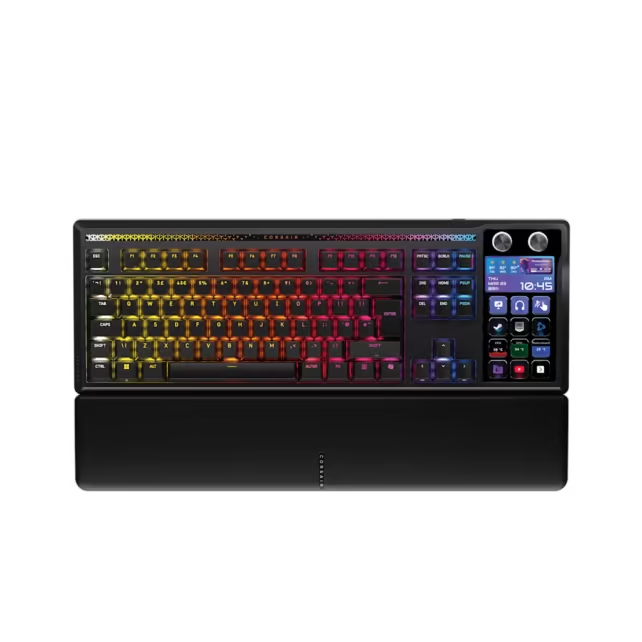
The Corsair Galleon 100 SD combines a high-performance gaming keyboard with a built-in Elgato Stream Deck interface, replacing the usual numpad area with 12 customizable LCD keys, two programmable dials, and a color screen. It’s aimed squarely at streamers and content creators who want game commands, media controls, voice-chat shortcuts, system stats, and streaming tools accessible without a second device cluttering the desk.
Independent reviews from Tom’s Hardware, TweakTown, and WIRED broadly agree this is a genuine mechanical keyboard rather than a novelty board with a screen bolted on — the aluminum-heavy construction, gasket mounting, sound dampening, pre-lubed MLX Pulse switches, and PBT keycaps are consistently praised. The largest recurring concern is value: at around $349.99 MSRP, the Galleon is roughly as expensive as buying a premium keyboard and a standalone Stream Deck separately, and it sacrifices a conventional numpad in the process.
Specifications
- Product: Corsair Galleon 100 SD Stream Deck-integrated mechanical keyboard
- Form factor: 87+12 keys (US); TKL layout with the Stream Deck occupying the numpad area
- Switches: Corsair MLX Pulse linear mechanical switches; pre-lubricated, 45g actuation force, 2.0mm actuation distance, 3.6mm total travel; rated for 80 million keystrokes; hot-swappable (3-pin and 5-pin)
- Keycaps: PBT double-shot and ABS single-shot components
- Backlighting: Programmable per-key RGB, 16.8 million colors, plus a top light strip
- Stream Deck hardware: 5-inch IPS color LCD screen, 12 LCD keys in a 3×4 grid, two machined-metal programmable dials
- Report rate: Up to 8,000Hz through Corsair AXON; default is 1,000Hz, with higher polling enabled through Web Hub
- SOCD handling: FlashTap; no Rapid Trigger, since switches are mechanical rather than Hall Effect
- Connectivity: Wired USB only, USB 3.0 or above recommended; detachable braided 1.8m/6ft USB-C to USB-A cable; secondary USB pass-through limited to USB 2.0
- Matrix: Full key rollover/NKRO with 100% anti-ghosting
- On-board profiles: Five
- Console compatibility: Xbox One, Xbox Series X|S, PlayStation 4, and PlayStation 5
- Software: Corsair Web Hub (keyboard configuration) and Elgato Stream Deck app (Stream Deck configuration), plus Elgato Marketplace plugins
- Case: Aluminum top case, plastic bottom case, gasket mounting, six layers of sound-dampening foam
- Accessories: Detachable magnetic wrist rest, keycap/switch puller, two braided USB-C-to-USB-A cables
- Dimensions: Keyboard 448 × 159 × 42mm; palm rest 448 × 89 × 21mm
- Weight: Keyboard 1,392g; palm rest 225g
- Warranty: Two years, subject to local regulations
- Price context: $299.99 sale / $349.99 original on Corsair’s official listing; independent reviews evaluated the keyboard at or around the $349.99 MSRP
Design, Build, and the Integrated Stream Deck
Without the Stream Deck, the Galleon is technically a TKL keyboard with alphabetic keys, a function row, arrows, and a 3×3 navigation cluster; Corsair treats the integrated Stream Deck as filling the numpad area instead. Tom’s Hardware measured the functional screen area at approximately 2.75 inches diagonally despite Corsair’s 5-inch diagonal display claim, since the LCD key area overlays the screen. The two dials are machined metal, textured, notched, and feel good in hand — one controls volume by default, and the other cycles Stream Deck pages or modes.
Build quality draws consistent praise: an aluminum top case, plastic bottom case, per-key RGB, a top light strip, non-skid feet, flip-out feet, and a detachable magnetic wrist rest. TweakTown described the hardware as a robust aluminum frame with multiple dampening layers that doesn’t compromise either the keyboard or the Stream Deck side. Tom’s Hardware found the wrist rest comfortable, though noted its leatherette covering may not be especially durable over long use. TweakTown’s main hardware criticism was that the secondary USB pass-through port is limited to USB 2.0, and WIRED noted the keyboard is roughly 50% wider than a standard 65% board, with the extra width sitting between the hands and potentially reducing mouse space.
Typing and Gaming Performance
Description
The Corsair Galleon 100 SD is a premium wired mechanical keyboard with a full Elgato Stream Deck built into the space normally occupied by a number pad. It offers a strong typing experience, 8,000Hz polling, hot-swappable MLX Pulse switches, two rotary dials, 12 LCD keys, and extensive game and productivity customization, but its $349.99 MSRP, large footprint, dual-software setup, and lack of a conventional numpad make it a specialized purchase rather than an obvious upgrade for everyone.Positives
- Excellent mechanical-keyboard hardware with a premium aluminum structure and stable construction.
- •
- Smooth, pre-lubricated MLX Pulse linear switches with a comfortable 45g actuation force.
- •
- Gasket mounting and six-layer sound dampening produce a refined, controlled sound profile.
- •
- Integrated Elgato Stream Deck provides 12 LCD keys, a color display, two dials, profiles, macros, and Marketplace plugins.
- Up to 8,000Hz polling and FlashTap/SOCD provide advanced gaming features.
- Hot-swappable switches and double-shot PBT keycaps improve customization and durability.
- Comfortable detachable magnetic wrist rest is included.
- Useful for streaming, MMO games, simulators, productivity, media control, system monitoring, and creative applications.
Negatives
- Expensive at a $349.99 MSRP, especially for buyers who do not need a built-in Stream Deck.
- Very large footprint can reduce mouse space and is difficult to justify on a small desk.
- Replaces the physical number pad with LCD keys that feel mushy and are not ideal for numeric entry.
- Standard mechanical switches do not offer Hall Effect features such as adjustable actuation or Rapid Trigger.
- Requires both Corsair Web Hub and Elgato Stream Deck software.
- Corsair Web Hub reliability was poor in Tom’s Hardware testing, although TweakTown reported a more acceptable experience.
- Stream Deck buttons can be difficult to view from the keyboard’s horizontal angle, according to WIRED.
- USB pass-through is limited to USB 2.0.
- Wired-only connectivity means there is no wireless option.
- Integrated Stream Deck hardware is complex and may be difficult to repair if the module fails.
The pre-lubed MLX Pulse linear switches were found smooth, straight, and somewhat “thocky” by Tom’s Hardware, and the six layers of sound-dampening foam significantly reduce case ping — an acoustic result Tom’s Hardware called impressive for a mainstream gaming keyboard. WIRED compared the gasket-mounted typing feel to “landing on a trampoline” and found the stabilizers well tuned with little rattle.
The standard TKL area performs well for gaming, with up to 8,000Hz polling available (though the default is 1,000Hz and higher polling must be enabled through Web Hub). Because the keyboard uses mechanical rather than magnetic switches, it doesn’t support Rapid Trigger, though it does support FlashTap/SOCD handling — WIRED liked the 8,000Hz rate for rapid single inputs and found SOCD useful for counter-strafing, while cautioning that games such as Counter-Strike 2 may restrict SOCD-style features in competitive play. TweakTown reported responsive switches and clean acoustics with no wobble or rattle, and found the integrated Stream Deck genuinely useful for games with many menus and controls, though its side-mounted position means the mouse hand often sits closer to the controls than the keyboard hand.
Software: Corsair Web Hub and the Stream Deck App
Software experience is where the three reviews diverge most. Tom’s Hardware reported severe Corsair Web Hub reliability problems, with the app connecting successfully only around three out of forty attempts across both online and installed versions, and a similarly troubled firmware-update flow. TweakTown experienced only a couple of connection drops and considered Web Hub generally solid for keyboard customization. This difference suggests software reliability may vary by system, firmware, or review unit rather than being a universal failure — still, it’s a meaningful risk worth factoring into a purchase decision.
The Elgato Stream Deck side of the software fared better across the board. Tom’s Hardware described it as smoother and functional, with a robust ecosystem and third-party Marketplace plugins, and the keyboard ships with a pre-installed profile containing gaming, media, and chat presets. TweakTown confirmed the Stream Deck app supports profiles and pages for Discord, Twitch, YouTube, emoji, system monitoring, and game-specific controls. WIRED, however, reported input delay on the Stream Deck portion during rapid-fire games, with delayed inputs occasionally intruding during typing, plus an unusual viewing angle since the LCD keys sit horizontally beside the keyboard rather than in a traditional vertical Stream Deck orientation — and found the rubber ring under the LCD keys made pressing feel inconsistent and mushy even when input registered correctly. These should be read as individual test findings rather than universal defects, but they’re worth knowing about.
Value for Money
At around $349.99, the Galleon 100 SD is roughly as expensive as buying a good keyboard and a standalone Stream Deck separately. Tom’s Hardware’s bottom line captured this tension well: a very good keyboard and a very good Stream Deck, but not a clear value advantage over the separate-purchase route. TweakTown reached a more favorable conclusion, calling it a niche but unique all-in-one product that could be essential for users who specifically value both functions in one device, while noting the integrated design saves desk clutter and creates a unified device at the cost of a conventional numpad and more desk space than compact keyboards.
WIRED landed closer to Tom’s Hardware, appreciating the Stream Deck’s flexibility and intuitive ecosystem but concluding that a separate $150 keyboard plus a $150 Stream Deck can offer similar functionality with greater flexibility. Repairability is also worth noting: the integrated Stream Deck module is secured by many screws and metal tabs and isn’t intended for easy user repair, so a failure could require module or full keyboard replacement.
Frequently Asked Questions
Is the Corsair Galleon 100 SD a real Stream Deck?
Yes, functionally. It runs the Elgato Stream Deck app and supports profiles, pages, and Marketplace plugins the same way a standalone Stream Deck does, integrated into the keyboard’s numpad area.
Does it have a numpad?
Not a conventional one. The 12 LCD Stream Deck keys occupy the numpad area, and while the left dial can switch to a numpad-like mode in hardware mode, Tom’s Hardware found the LCD keys mushier than conventional keys and not a perfect numpad replacement.
Does it support Rapid Trigger?
No. The Galleon uses standard mechanical MLX Pulse switches rather than Hall Effect switches, so actuation isn’t adjustable and Rapid Trigger isn’t available. It does support FlashTap/SOCD handling.
Is the Corsair Web Hub reliable?
Reports vary. Tom’s Hardware experienced severe connection problems, while TweakTown found it generally solid with only occasional drops. This suggests reliability may depend on your system or firmware version, so treat it as a real but not universal risk.
Is it worth buying instead of a separate keyboard and Stream Deck?
It depends on your priorities. Tom’s Hardware and WIRED both felt a separate keyboard and Stream Deck could offer similar functionality with more flexibility for similar total cost, while TweakTown saw genuine value in the unified, desk-saving design for users who want both specifically.
Verdict
The Corsair Galleon 100 SD earns approximately 4.0 out of 5 stars. It’s a genuinely excellent mechanical keyboard on its own merits — aluminum-heavy construction, gasket mounting, six layers of sound dampening, smooth pre-lubed switches, and PBT keycaps — married to a real, flexible Elgato Stream Deck with 12 LCD keys, two dials, and a color screen.
Its trade-offs are the loss of a conventional numpad, a large desk footprint, standard mechanical rather than Hall Effect switches, and a value proposition that’s genuinely debatable against buying a keyboard and Stream Deck separately. Software reliability also varies by review, with Corsair Web Hub drawing sharp criticism from one outlet and a much better experience from another. This is a niche but compelling product for streamers and creators who specifically want a unified keyboard-and-Stream-Deck device — less essential for anyone who doesn’t need the integrated Stream Deck functionality.
