

The Turtle Beach Stealth Pro II is a feature-packed premium wireless headset with excellent audio potential, effective active noise cancellation, a very good boom microphone, simultaneous 2.4 GHz and Bluetooth, CrossPlay 2.0 multi-transmitter switching, and dual hot-swappable batteries. Its two 40-hour battery packs and charging/transmitter dock can provide practically continuous use.
The major drawbacks are its heavy chassis, possible suspension-headband durability concerns, imperfect out-of-box tuning, occasional software roughness, the lack of a 3.5 mm input, and a high price. It is a powerful choice for serious multiplatform players, especially those who game in noisy environments, but its fit and weight should be considered carefully.
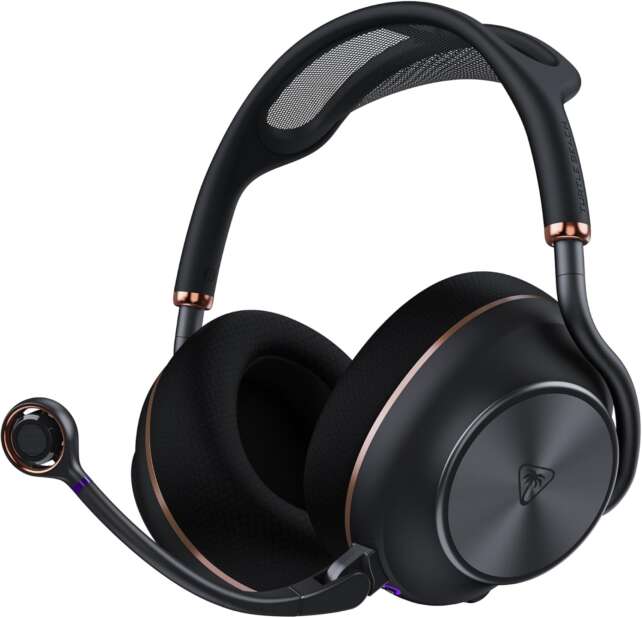
The Stealth Pro II is Turtle Beach’s flagship wireless gaming headset for 2026. It combines 60 mm Eclipse Dual Drivers, Dolby Atmos, high-resolution wireless and wired audio, gaming-focused ANC, a detachable 9 mm floating microphone, a backup integrated microphone, Bluetooth 5.3, and Turtle Beach’s CrossPlay 2.0 transmitter system.
The most distinctive feature is the battery arrangement. The headset includes two rechargeable battery packs, each rated for up to 40 hours. One battery powers the headset while the second charges in the included dock, so users can swap packs and continue playing with only a short interruption. This solves the most common weakness of wireless headsets: eventually having to stop and plug in.
Description
The Turtle Beach Stealth Pro II is a feature-packed premium wireless headset with excellent audio potential, effective active noise cancellation, a very good boom microphone, simultaneous 2.4 GHz and Bluetooth, CrossPlay 2.0 multi-transmitter switching, and dual hot-swappable batteries. Its two 40-hour battery packs and charging/transmitter dock can provide practically continuous use.The major drawbacks are its heavy chassis, possible suspension-headband durability concerns, imperfect out-of-box tuning, occasional software roughness, the lack of a 3.5 mm input, and a high price. It is a powerful choice for serious multiplatform players, especially those who game in noisy environments, but its fit and weight should be considered carefully.
Positives
- Excellent 2.4 GHz gaming performance with low latency.
- Dual 40-hour hot-swappable battery system.
- Included charging/transmitter dock.
- Simultaneous Bluetooth and 2.4 GHz audio.
- CrossPlay 2.0 supports switching among up to four 2.4 GHz transmitters.
- Strong ANC, especially against low-frequency rumble.
- Excellent boom microphone with AI noise reduction and EQ.
- Useful backup integrated microphones.
- Powerful, detailed audio after EQ adjustment.
- Strong spatial positioning in tactical shooters.
- Dolby Atmos support on Xbox and PC.
- 24-bit/96 kHz wireless audio on PC and compatible systems.
- Hard-shell storage case included.
- Premium aluminum and soft-touch design elements.
- USB-C wired audio and charging.
- ProSpecs-style glasses relief and memory-foam cushions.
Negatives
- Heavy at approximately 393–395 g.
- Some reviewers experienced discomfort after a few hours.
- Possible long-term loosening of the suspension headband.
- ANC can create an uncomfortable cabin-pressure or vacuum sensation.
- Default sound is boomy and benefits from EQ.
- Treble can become sibilant, and dialogue may sound recessed.
- Sound consistency depends on seal, glasses, hair, and fit.
- Swarm II can be unstable and firmware updates may be slow.
- Volume controls are imprecise in large steps.
- No 3.5 mm input.
- Large travel case takes up space.
- No direct ANC-off option on the headset controls.
- Xbox and PlayStation versions have different compatibility.
- Expensive at $349.99.
- Not stable enough for vigorous movement and has no IP rating.
CrossPlay 2.0 adds unusual multiplatform flexibility. The package includes a transmitter dock and a USB transmitter, while additional transmitters can be purchased to support switching among up to four paired 2.4 GHz sources. The headset can also maintain a simultaneous Bluetooth connection, allowing a phone call or mobile audio to play alongside game audio.
Audio quality is strong after tuning but not universally ideal out of the box. IGN found the default sound boomy, while SoundGuys reported strong tactical-shooter positioning but also sibilant treble and recessed dialogue. The dual-driver system delivers significant bass and useful separation, but the Swarm II EQ is important for bringing the midrange and high-frequency details into better balance.
ANC is one of the headset’s strongest technical features. Turtle Beach uses four internal microphones and rates the system for up to 25 dB of reduction. SoundGuys measured an average 81% perceived-noise reduction with a good seal, and RTINGS found very good overall isolation. The trade-off is a noticeable pressure or vacuum sensation for some users, along with weaker reduction of nearby voices.
Comfort is more complicated. The fabric suspension headband and memory-foam cushions distribute the weight effectively, and IGN found the headset comfortable for several hours. However, the Stealth Pro II weighs approximately 393–395 g, and SoundGuys found it uncomfortable around the two-hour point. The mesh headband may also loosen over time.
Specifications
- Product: Turtle Beach Stealth Pro II Wireless Gaming Headset
- Design: Closed-back over-ear headset
- Drivers: 60 mm Eclipse Dual Drivers with separate woofer and tweeter elements
- Frequency response: 10 Hz–40 kHz
- Wireless connection: Low-latency 2.4 GHz USB wireless
- Bluetooth: Bluetooth 5.3 with simultaneous use alongside 2.4 GHz
- Bluetooth codecs: LDAC and LC3 support reported by SoundGuys and RTINGS
- Wired connection: USB-C audio and charging
- 3.5 mm input: Not included
- Microphone: Detachable, unidirectional, flip-to-mute 9 mm floating boom
- Microphone frequency response: 100 Hz–16 kHz
- Integrated microphones: Built-in beamforming microphones for backup voice use
- ANC: Adjustable active noise cancellation using four internal microphones
- Official ANC claim: Up to 25 dB of background-noise reduction
- Spatial audio: Dolby Atmos on Xbox and PC
- High-resolution audio: Up to 24-bit/96 kHz on PC and compatible devices; Xbox and PlayStation are limited to 16-bit/48 kHz
- Battery: Two swappable rechargeable batteries, each rated for up to 40 hours
- Weight: 393 g with boom microphone; 382 g without boom microphone
- Ear cushions: Athletic-weave fabric and memory foam
- Headband: Fabric suspension headband
- Software: Turtle Beach Swarm II for PC, iOS, and Android
- EQ: 10-band headset and microphone EQ
- Wireless switching: CrossPlay 2.0 supports up to four paired 2.4 GHz transmitters
- Included accessories: USB transmitter, transmitter dock, USB-A-to-USB-C charging cable, two batteries, and hard-shell storage case
- Compatibility: Xbox Series X|S, Xbox One, PlayStation 4/5, Windows PC, and Bluetooth mobile devices, depending on variant
- Official price cited: $349.99
Design and Build Quality
The Stealth Pro II is substantially more refined-looking than the original Stealth Pro. Its mixed-material design combines matte plastic, brushed or anodized aluminum, chrome accents, soft-touch surfaces, and fabric cushions. With the microphone removed, it can pass as a premium everyday headphone more easily than many gaming headsets.
The controls are concentrated around the ear cups and include volume controls, ANC and listening-mode controls, Bluetooth pairing, Superhuman Hearing, and CrossPlay switching. The system is powerful but can take time to memorize, particularly because the headset uses separate controls for game, chat, and Bluetooth volume.
The volume rollers are a weak point. SoundGuys found their large tactile steps unpleasant and imprecise, with Windows volume changing in increments of four. This is not necessarily a problem once the preferred volume is set, but it makes small adjustments less convenient.
The included dock is compact and serves as both a wireless transmitter and a battery charger. It uses an illuminated ring to communicate connection or microphone status and includes an eject button for the spare battery. It lacks the OLED display and menu controls found on some competing base stations, but its primary jobs are simple and useful.
The headset also folds flat and comes with a hard-shell case. The case is bulky, but it provides meaningful protection for travel and has space for the accessories.
Comfort and Fit
The Stealth Pro II’s comfort depends heavily on how the user reacts to weight and clamping pressure. It weighs approximately 393 g with the boom microphone attached, making it heavier than many competing wireless headsets.
The suspension headband and soft memory-foam cushions distribute that mass better than a conventional padded band. IGN found the headset comfortable for several hours, and RTINGS also considered it comfortable despite its high weight.
SoundGuys had a less favorable experience. The reviewer found the thin fabric suspension band placed noticeable pressure on the head, with discomfort developing around two hours and a need for a break around five hours. RTINGS also warned that the mesh headband may loosen over time.
The ear cushions create a strong seal and use a curved shape that can sit flush against the head. The yokes swivel to improve fit, and the design includes ProSpecs-style relief for glasses. The seal can also create a vacuum sensation, which may be uncomfortable for users sensitive to pressure changes.
The headset is not ideal for vigorous movement. RTINGS found it unstable during strenuous activity, and there is no IP rating. It is designed for seated gaming, travel, office work, and media consumption rather than exercise.
Audio Quality
The 60 mm Eclipse Dual Drivers are one of the Stealth Pro II’s central upgrades. Each side separates the low frequencies from the midrange and treble through a dual-driver arrangement, allowing the headset to deliver substantial bass while retaining more detail than a conventional bass-heavy gaming headset.
The default profile is not neutral. IGN found it boomy and powerful but lacking definition, while SoundGuys found the headset capable of excellent tactical-gaming performance but too sibilant for extended listening. Dialogue may also sound recessed or muddy in busy scenes.
EQ adjustment is therefore strongly recommended. IGN used Swarm II to reduce the boom and bring the mids and highs forward. Once tuned, the headset became full, detailed, and enjoyable for both music and games. SoundGuys similarly found strong competitive performance, particularly for footsteps and spatial width, while noting that some battle-royale mixes remained difficult to parse.
The headset’s frequency response can vary with fit. RTINGS found mediocre consistency and warned that glasses, hair, and earpad seal can influence bass delivery. Users should ensure that the cushions are mounted correctly and form a consistent seal before judging the sound.
The 10 Hz–40 kHz response specification exceeds the range of human hearing, but the practical benefit comes from the driver design, tuning, and processing rather than the number itself. The headset supports high-resolution wireless audio on PC and compatible devices, although Xbox and PlayStation are limited to 16-bit/48 kHz.
Gaming Performance and Spatial Audio
The Stealth Pro II is particularly strong in tactical shooters. SoundGuys reported excellent spatial width and good depth perception, making it easy to identify the direction and approximate distance of footsteps in Counter-Strike and Valorant.
In more crowded mixes such as Apex Legends or Marvel Rivals, separating gunfire, grenades, footsteps, abilities, and dialogue requires more effort. The headset’s bass energy can make a busy scene feel exciting, but it can also obscure midrange information before EQ adjustment.
Dolby Atmos is supported on Xbox and PC, and Turtle Beach also provides Superhuman Hearing modes designed to emphasize footsteps or gunfire. These modes can help in tactical games but deliberately suppress other parts of the mix. SoundGuys found them useful in appropriate titles but muffled and less suitable for games with complex or unconventional audio.
The low-latency 2.4 GHz connection is suitable for competitive gaming. RTINGS found dongle latency low enough for games that depend on audio cues, and SoundGuys reported no noticeable wireless lag through the dock.
The result is a headset with excellent competitive potential after tuning, especially for players who value footstep positioning and strong environmental immersion. It is less naturally balanced for dialogue-heavy games or users who want a neutral sound without applying EQ.
Active Noise Cancellation and Isolation
ANC is a major reason to consider the Stealth Pro II. Turtle Beach uses four internal microphones and claims up to 25 dB of reduction. SoundGuys measured an average 81% reduction in perceived outside noise when the earpads were properly installed, while RTINGS found very good overall isolation.
The system is effective against low-frequency sounds such as air-conditioning, engines, and train rumble. This makes the headset useful for noisy homes, travel, and open-office environments.
Speech is more difficult. RTINGS notes that ANC is less active in the midrange, and SoundGuys could still make out people talking nearby. Wind can also reduce performance.
The headset’s ANC may produce a noticeable cabin-pressure or vacuum sensation. IGN found this effect especially pronounced, and SoundGuys also described the seal as capable of creating a vacuum feeling. Users sensitive to ANC pressure should try the headset before committing if possible.
The ear-cup button toggles between ANC and Transparency rather than offering a direct off mode. To disable noise control completely, users must use Swarm II.
Microphone Quality
The detachable 9 mm floating boom microphone is one of the headset’s strongest components. Its unidirectional design and floating suspension reduce handling vibration, while AI-based noise reduction and beamforming focus on the speaker’s voice.
IGN described the microphone as unusually full-bodied for a wireless gaming headset, with a quality closer to a desktop microphone than a typical boom. RTINGS found remarkable noise handling when the boom was used through the 2.4 GHz transmitter with AI Noise Reduction enabled.
Swarm II provides microphone EQ, sensitivity, noise gate, and related controls. Users can shape the voice toward a warmer, brighter, or more radio-like presentation.
The microphone flips to mute and is detachable for travel. When the boom is removed, built-in beamforming microphones provide a backup voice mode. RTINGS found the integrated and Bluetooth modes weaker than the boom, but their existence makes the Stealth Pro II more usable for calls and casual listening without the gaming microphone attached.
Wireless Connectivity and CrossPlay 2.0
The Stealth Pro II supports low-latency 2.4 GHz wireless, Bluetooth 5.3, USB-C wired audio, and simultaneous 2.4 GHz plus Bluetooth audio. The simultaneous mode is useful for receiving a phone call or listening to mobile audio while playing a console or PC game.
CrossPlay 2.0 expands the system beyond ordinary dual-wireless operation. The included transmitter and dock can be paired with a second USB transmitter, and additional transmitters can be purchased to support up to four 2.4 GHz sources. A button on the right ear cup can switch among paired sources.
The system is especially valuable for players who own multiple consoles. IGN switched between Xbox and PS5 with a button press, while RTINGS and SoundGuys confirmed low-latency performance through the transmitter and dock.
Variant selection matters. Turtle Beach sells Xbox and PC/PlayStation versions. The Xbox model works across Xbox, PlayStation, and PC, whereas the PlayStation model lacks the hardware needed for Xbox support. Buyers who own multiple platforms should choose the Xbox version if it is available and compatible with their region.
Battery Life and Charging
The headset includes two batteries, each rated for up to 40 hours. In normal use, one battery powers the headset while the other remains charged in the dock. Swapping takes only moments, though there is a brief audio interruption.
Independent results support the headline claim. IGN achieved approximately 40 hours per battery, SoundGuys measured 41 hours and 8 minutes with ANC enabled, and RTINGS measured more than 47 hours under its test conditions. Battery life varies with ANC, volume, connection, and software settings, but the overall endurance is excellent.
The hot-swappable system is more useful than a very large single battery because it removes charging downtime. The main requirement is remembering to place the spare battery in the dock after swapping. If the spare is empty, the practical advantage disappears.
The headset can also charge and operate through USB-C. This provides a backup when both batteries are low and retains active features such as ANC and software customization.
Software and Controls
Swarm II provides a wide set of options: headset and microphone EQ, presets, ANC, sidetone, Superhuman Hearing, noise gate, button remapping, hotkeys, power settings, firmware updates, and device profiles. It is available on PC, iOS, and Android.
The software is functional but not especially polished. IGN found the interface less developed than Corsair iCUE or Razer Synapse, and its first firmware update repeatedly stalled before eventually taking 15–20 minutes. SoundGuys also experienced crashes and needed to reinstall the application during testing.
The good news is that users do not need to create an account to access the controls. Once settings are configured, EQ profiles can be stored on the headset, reducing the need to leave Swarm II running on a PC.
The hardware controls are comprehensive enough that everyday use does not require opening the app. However, some functions are layered onto the same buttons, and the large volume steps may frustrate users who need precise adjustment.
Travel and Everyday Use
The Stealth Pro II is more suitable for travel than the original model because it includes a hard-shell case, Bluetooth, ANC, a backup integrated microphone, and a long-lasting battery system. RTINGS found it comfortable enough for travel and capable of reducing airplane or bus rumble.
Its size and weight are the main travel disadvantages. The case occupies significant luggage space, and the headset itself is heavy. There is also no 3.5 mm input, so it cannot connect to some airplane entertainment systems.
The headset can appear relatively normal when the boom microphone and RGB-style gaming cues are absent, making it more appropriate for calls and music than many gaming headsets. Its ANC pressure and heavy fit nevertheless make it less universally comfortable than a conventional travel headphone.
Value for Money
The official price is $349.99, placing the Stealth Pro II in the premium tier. That price is high, but the feature set is unusually broad: dual batteries, dock, ANC, simultaneous wireless, 24-bit/96 kHz PC audio, CrossPlay 2.0, a hard-shell case, Dolby Atmos, and a strong boom microphone.
The value is strongest for users who will actively use those features. A single-console player who does not need simultaneous wireless, ANC, or a hot-swappable battery may find less expensive headsets more sensible. A multiplatform player with a noisy environment can benefit substantially from the system.
The biggest value risk is comfort. A $349.99 headset must be comfortable for long sessions, and independent reviews disagree because weight and pressure are highly personal. Buyers should pay close attention to return policies and fit.
Who Should Buy the Turtle Beach Stealth Pro II?
The Stealth Pro II is best for multiplatform gamers who want one headset for Xbox, PlayStation, PC, mobile audio, calls, and travel. It is especially compelling for users who need ANC, a hot-swappable battery system, simultaneous game-and-phone audio, or frequent switching among several consoles and PCs.
It is less suitable for users who dislike heavy headsets, are sensitive to ANC pressure, require a 3.5 mm cable, need a perfectly balanced sound without EQ, or expect polished software. Buyers should verify the platform variant before purchase and should treat comfort as a personal fit decision rather than assuming the suspension headband will suit everyone.
Frequently Asked Questions
Is the Turtle Beach Stealth Pro II worth buying?
Yes, if you will use its premium features. The dual batteries, dock, ANC, simultaneous wireless, CrossPlay 2.0, strong microphone, and broad platform support make it unusually versatile. Its high price and heavy fit make it less compelling for users who need only basic wireless audio.
What is the difference between the Xbox and PlayStation versions?
The Xbox version has the hardware required for Xbox compatibility and also works with PlayStation and PC. The PC/PlayStation version works with PlayStation and PC but does not support Xbox. If you own both Xbox and PlayStation, the Xbox version is generally the more flexible option.
Does the Stealth Pro II support simultaneous Bluetooth and 2.4 GHz?
Yes. You can use the low-latency wireless connection for game audio while receiving calls or playing audio from a Bluetooth phone.
How long does each battery last?
Turtle Beach rates each of the two batteries for up to 40 hours. Independent tests measured approximately 40 to more than 47 hours depending on conditions.
Can the batteries be replaced while gaming?
Yes. One battery can be removed and replaced with the charged spare while the headset is in use. There is a short audio interruption, but the system avoids the long downtime associated with plugging in a conventional headset.
Does the Stealth Pro II have ANC?
Yes. It uses four internal microphones for adjustable ANC. Turtle Beach claims up to 25 dB of reduction, and independent testing found strong performance against low-frequency rumble.
Does ANC block voices?
Only partially. The system is strongest against low-frequency noise such as engines and air conditioners. Nearby speech can remain audible because midrange attenuation is less effective.
Does the Stealth Pro II cause ANC pressure?
It can. IGN and SoundGuys both reported a noticeable cabin-pressure or vacuum sensation. Users sensitive to ANC pressure should try the fit before committing if possible.
Is the microphone good?
Yes. The detachable floating 9 mm boom microphone provides full-bodied and clear voice quality, especially when AI Noise Reduction is enabled through the 2.4 GHz connection.
Can I use the Stealth Pro II without the boom microphone?
Yes. Built-in beamforming microphones provide backup voice capability, although independent testing found them weaker than the detachable boom.
Does the Stealth Pro II support Dolby Atmos?
Yes. Dolby Atmos spatial audio is supported on Xbox and PC.
Does it support high-resolution wireless audio?
Yes, up to 24-bit/96 kHz on PC and other compatible systems. Xbox and PlayStation are limited to 16-bit/48 kHz according to Turtle Beach’s official information.
Is the Stealth Pro II good for FPS games?
Yes. RTINGS and SoundGuys found low latency, strong spatial width, and good footstep positioning in tactical shooters. The default bass-heavy tuning should be adjusted if explosions obscure midrange cues.
What does Superhuman Hearing do?
Superhuman Hearing emphasizes audio cues such as footsteps and gunfire. The Stealth Pro II provides three adjustable levels, but the modes reduce other parts of the sound mix and are best reserved for suitable tactical games.
Does the Stealth Pro II have a 3.5 mm input?
No. It supports USB-C wired audio but lacks a 3.5 mm analog input.
Is the Stealth Pro II comfortable?
It can be comfortable for several hours because of the suspension headband and memory-foam cushions, but it is heavy. Independent reviewers disagree: IGN and RTINGS found the weight well distributed, while SoundGuys experienced discomfort around two hours.
Is the headset suitable for travel?
Yes, with reservations. It has ANC, Bluetooth, long battery life, a backup microphone, and a hard-shell case. However, the case is large, the headset is heavy, and the lack of a 3.5 mm input limits use with some airplane entertainment systems.
Does the Stealth Pro II work while charging?
Yes. USB-C wired operation can charge the headset while it is being used, and active features such as ANC remain available.
Is the Swarm II software good?
It is feature-rich but not especially polished. It provides EQ, mic controls, ANC, profiles, hotkeys, firmware updates, and Superhuman Hearing, but IGN and SoundGuys encountered slow updates, crashes, or setup problems.
Verdict
The Turtle Beach Stealth Pro II earns 4 out of 5 stars. It is one of the most versatile gaming headsets available, combining strong tactical audio, powerful ANC, a high-quality boom microphone, simultaneous game-and-phone wireless, a genuinely useful dual-battery system, CrossPlay 2.0 switching, a hard case, and broad console support. Few competitors offer this entire package in one headset.
Its weaknesses prevent a higher score. The headset is heavy, the suspension band may not suit every head or remain tight over time, ANC can create pressure, the default sound requires EQ, and Swarm II is less reliable and polished than the best competing software. The missing 3.5 mm input and high price further narrow its audience.
Buy it if you want a premium multiplatform headset with ANC, hot-swappable batteries, simultaneous wireless, and excellent microphone performance. Look elsewhere if you need a lightweight headset, a neutral out-of-box sound, polished software, or a 3.5 mm analog input.
